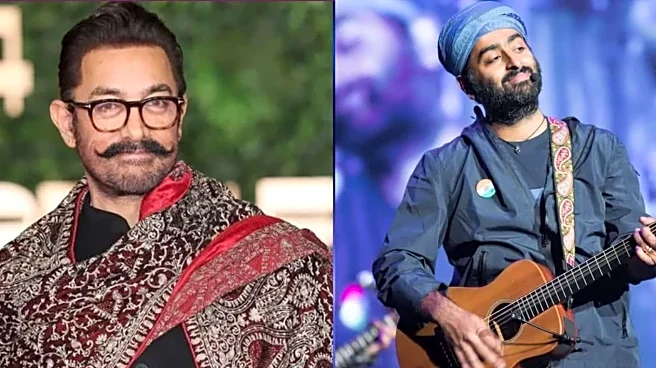
Arijit Singh recently performed at Anoushka Shankar’s Kolkata concert after announcing his exit from Bollywood playback. This was Arijit’s first public act following his announcement on January 27. To be fair, when Arijit Singh and Anoushka Shankar shared the stage in Kolkata, it was not only a crossover moment between two global music icons, but it was much more than that. The performance, which also saw the iconic percussionist Bickram Ghosh playing along, was a convergence of legacies, lineages and lived histories. The evening became even more unforgettable when the duo performed Maya Bhora Raati, which is intricately associated with the legendary Pandit Ravi Shankar. Rarely played, the rendition was both intimate and historic, steeped deeply
in Bengal’s cultural memory.
A Meeting of Worlds, Rooted in Tradition
Arijit Singh, one of India’s most influential playback singers is known for his grounding in classical and semi-classical traditions. Anoushka Shankar, sitar virtuoso and composer, is not only a global torchbearer of Indian classical music but she is also the daughter and disciple of Pandit Ravi Shankar - the maestro who redefined Indian music’s dialogue with the world. Their collaboration in Kolkata was termed by the audience as both inevitable and extraordinary. It was not a commercial pairing, designed for virality. Instead, their collaboration was one that honoured the city’s cultural DNA and its towering artistic figures.
Maya Bhora Raati And The Ravi Shankar Connection Explained
Maya Bhora Raati, a rare Bengali composition, became the focal point for the collaboration.
Maya Bhora Raati, a Bengali classic song composed by the legendary sitar maestro Pandit Ravi Shankar, is often associated with Hindustani classical, and was originally sung by Lakshmi Shankar, the sister-in-law of Ravi Shankar. The piece is deeply rooted in Hindustani classical tradition, often accompanied by sitar. The lyricist of the song was another legend Shyamal Gupta. The composition requires a delicate balance between classical improvisation and lyrical restraint - a balance Ravi Shankar mastered effortlessly.
Pandit Ravi Shankar and Bengali Music
Pandit Ravi Shankar, though celebrated globally as a sitar virtuoso, remained profoundly rooted in Bengali musical traditions. His most iconic Bengali contribution came through his immortal scores for Satyajit Ray’s The Apu Trilogy - Pather Panchali (1955), Aparajito (1956), and The World of Apu (1959) - where his music became inseparable from the emotional grammar of Bengali cinema.
His engagement with the language and its cultural moment was also evident in Joi Bangla, a 1971 EP produced by George Harrison to support the Bangladesh Liberation War, which featured two rare Bengali vocal compositions, Joi Bangla, a stirring call for unity, and Oh Bhagawan. His Bengali filmography also includes Tapan Sinha’s Kabuliwala (1957), for which he received the Silver Bear Extraordinary Prize at the Berlin International Film Festival. As for Arijit Singh, singing Maya Bhora Raati at Netaji Indoor Stadium in Kolkata reaffirmed his identity beyond playback stardom - as a musician deeply conscious of India’s classical and literary traditions.
/images/ppid_a911dc6a-image-177062202898221219.webp)

/images/ppid_59c68470-image-177062004190524024.webp)
/images/ppid_59c68470-image-17706200243254067.webp)






/images/ppid_a911dc6a-image-177062083254192483.webp)


/images/ppid_59c68470-image-177062020106260359.webp)

/images/ppid_59c68470-image-177062007529427300.webp)
/images/ppid_59c68470-image-177062010686465812.webp)