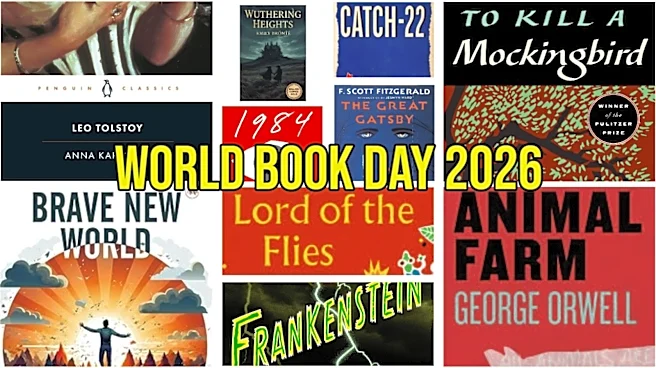
I first read JK Rowling’s Harry Potter, much before the novels made their way to the big screen. And while they were all wonderful cinema that satiated the audience soul, I was not satisfied, just not satisfied. Something was missing – a nagging sensation that kept on pricking me at the back of my mind. On the occasion of World Book Day, as I kept on perusing the internet looking for popular books that have been turned into blockbuster cinema, the thought silently crept back in my mind, rekindling an age-old debate – why do beloved books so often feel diminished when adapted for the big screen? From Harry Potter (though they are trying to right that wrong) to George RR Martin’s Game of Thrones (perhaps the most blatant example ever) to even
Kill a Mockingbird, the pattern is striking. Even the most celebrated adaptations – critically acclaimed (The Shining, 1980), commercially successful (I Am Legend, 2007) and culturally influential (The Great Gatsby, 2013) – rarely capture the full emotional depth of their source material. The issue is quite complex actually, it is not about books being better, but rather a fundamental difference in how each medium conveys human experience.
And at the centre of this divide lies a simple truth – books and visual storytelling operate through entirely different emotional mechanisms. Where literature and as an extension novels, invite readers inward, cinema projects outward and that distinction shapes everything.
The Interior World Of Books Vs. The External Image In Cinema
Basically books excel at interiority. Through prose, authors grant readers a direct access to the character’s thoughts, fears and contradiction as well as evolving perceptions. Think of it as a POV medium where readers view what the protagonist is viewing but through their own mind’s eye. This internal landscaping is often where the deepest emotional resonance lives.For example, take Harry Potter. Across seven novels, readers are immersed in Harry’s internal struggles – his loneliness, his moral dilemmas, his gradual reckoning with loss and identity. While the film too chronicles the broad arc of his journey, they inevitably sacrifice so much of his inner texture. Quiet reflections like Harry’s though on Cedric Diggory’s death, his conflicted feelings towards Snape, or his simmering anger in Order of Phoenix - are largely compressed or even omitted in films. What remains is a streamlined narrative that focuses on plot progression over psychological nuance.
Cinema relies on what can be seen and heard. While skilled filmmakers and as an extension actors can try and emote inner turmoil through performance, light or music – these tools are indirect. While a lingering close-up or a score can evoke emotion, it cannot replace the specificity of a character’s internal monologue, leading to what can be termed as the flattening of emotional complexity.
Time And How It Plays On Cinema And Books
Another key factor is time. Novels unfold a pace determined by the reader. A single paragraph can be lingered upon – read, reread and internalised. The flexibility allows emotions to see a gradual build up often in subtle ways. On the other hand, film and television are bound by a specific runtime. Even expansive series face constraints of pacing and audience engagement – thus necessitating compression where subplots are trimmed, characters merged or obliterated and slow emotional arcs- accelerated.
Game of Thrones is perhaps one of the most compelling examples in recent history. In its early seasons, when it closely followed George RR Martin’s books, the show maintained a careful balance between plot and character development. However, with time, it started outpacing the source material and became extremely rushed. Complex character motivations - Daenerys Targaryen’s transformation, Jaime Lannister’s moral arc - were condensed into abrupt shifts that left many viewers disconnected. On the other hand, the books, devote hundreds of pages to these transitions, allowing readers to inhabit the lives and perspectives of the characters and understand their choices, however troubling they may be within the scope of the narrative.
Reader’s Imagination vs. the Director’s Vision
One of literature’s greatest strength lies in interpretation. While a book provides a framework, the reader completes the experience. The appearance of characters, voices and even tone of a scene is partially constructed in the reader’s imagination, which creates a deep personal connection. On the other hand, cinematic adaptations replace this multiplicity with a single, fixed interpretation. From the actor, to the set and tone of performance, everything becomes definitive and while this can be powerful in terms of interpretation, it also limits the range of emotional engagement.Harper Lee’s To Kill a Mockingbird is a compelling example of a novel that is filtered through the perspective of Scout Finch, whose childlike understanding lends a unique emotional texture to the text. Readers experience the events in the book as Scout interprets them. The film adaptation, while highly praised cannot fully replicate this narrative, shifting the tonality from being a subjective experience to an observational one.
This shift alters the emotional dynamic in the film. Where, in the book, readers grow alongside Scout, sharing in her gradual realisation of injustice and empathy, in the film, those realisations are presented rather than discovered.
The Importance of Language as an Emotional Medium
From the rhythm of a sentence, choice of words and use of metaphor, all contribute to how a scene is felt. Cinema, while rich in visual and auditory elements, cannot replicate the precise emotional calibration of language. Dialogue must be economical; since too much exposition risks feeling unnatural. Thus, much of the emotional weight carried by prose is either translated into visual cues or lost altogether.This is best seen in adaptations of literary works known for their stylistic depth. In F Scott Fitzgerald’s The Great Gatsby, prose conveys a sense of longing and disillusionment that is inseparable from the language itself. And while film adaptations can recreate the setting and plot, the ineffable quality of the author’s remains elusive.
Silence and Ambiguity
The ambiguity offered by books, allowing space for interpretation is absent in cinema. While books thrive on emotional uncertainty, visual storytelling often demands clarity – what is shown must be comprehended in the moment. While some films do embrace ambiguity, mainstream adaptations frequently lean toward explicitness to ensure accessibility. And this can often dilute emotional impact. In literature, what is left unsaid can be as powerful a tool as to what is stated. Pauses, silences or unresolved tension can resonate deeply precisely because it is not fully explained.
Not all cinema however, fails in using this. Mike Nihols' 1966 film Who's Afraid Of Virginia Woolf? starring Elizabeth Taylor and Richard Burton, used pauses and silences in compelling manner, creating a cult cinema in the process. Similarly the 2008 film The Boy in the Striped Pyjamas too played wonderfully on this device.
Collective vs. Solitary Experience
Finally, perhaps the most compelling thing lies in how each medium is consumed. Reading is typically a solitary act and requires focus, imagination and emotional investment. This intimacy creates a bond between reader and text. On the other hand, watching a film or series is often a more passive and sometimes communal experience. And while it can be emotionally engaging, it does not demand the same level of participation.
Transformation
We cannot call adaptations failures. They are transformations and reinterpretations that translate a story into different languages, where some succeed brilliantly on their own terms, even if they diverge from the emotional experience of the source material. The enduring appeal of adaptations like Harry Potter, Game of Thrones, and To Kill a Mockingbird lies in their ability to bring stories to new audiences, to visualise worlds that once existed only in imagination, and to spark renewed interest in the original texts.
/images/ppid_a911dc6a-image-177693959140944201.webp)

/images/ppid_a911dc6a-image-177666306959219645.webp)






/images/ppid_a911dc6a-image-177678207738573053.webp)

/images/ppid_a911dc6a-image-177669810390323016.webp)