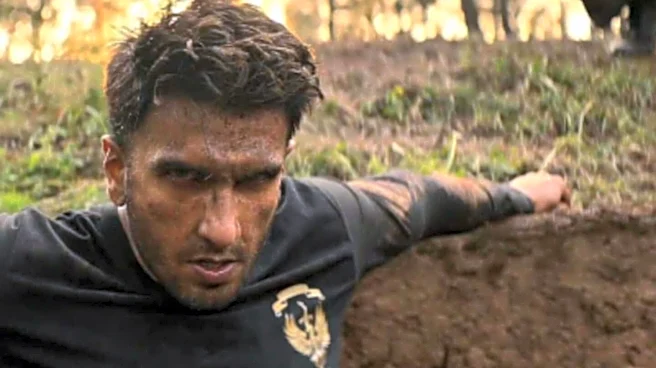
That Ranveer Singh completely owned theatres with his act as Hamza Ali Mazari in Aditya Dhar’s Dhurandhar and Dhurandhar 2 would perhaps be an understatement. Singh’s act as Jaskirat and Hamza both us fury-induced and haunting. To be honest, few contemporary actors in Hindi cinema embody emotional volatility like Ranveer Singh. Not taking anything away from Singh’s contemporaries, but the truth is, there are actors who ‘play’ anger and then there are those who seemingly summon it from somewhere primal – making it unpredictably dangerous and yet oddly human. Ranveer Singh, in films whose tonality as markedly different as Dhurandhar (1 and 2), Bajirao Mastani, Gully Boy and Padmaavat, has not only showcased his range, but has carved a unique relationship
with rage itself. Ranveer Singh’s rage, in these films, shifts shape, texture, and meaning depending on the lives his characters love and the world they inhabit.What makes Ranveer Singh particularly persuasive is that his range is far from generic. It is not the loud, declamatory anger than often defines mainstream cinematic heroes. Instead, his is a calibrated anger that sometimes simmers beneath the surface and at times erupts with terrifying abandon or manifests as a quiet, internal combustion. His anger is at one time political, at another romantic, wounded or downright pessimistic.
Take for instance
Sanjay Leela Bhansali’s Bajirao Mastani. The 2015 film saw Ranveer portraying Peshwa Bajirao and as an extension stepping into a role that is seeping in warrior’s rage.
Bajirao – and as an extension – Ranveer’s rage is controlled, disciplined yet always at the risk of spilling over. His anger is not of insecurity, but of conviction. Bajirao’s fury stems from his steadfast belief in duty, love for Mastani and his defiance of societal constraints and convictions. Ranveer navigated the character as a man constantly negotiating between restraint and explosion. His eyes would harden in moments of confrontation, his voice would rise in intensity, never in pitch – his rage – regal, almost poetic – one matching Bhansali’s operatic sensibilities.
In contrast, the
2018 Padmaavat sees Ranveer inhabiting the skin of Alauddin Khilji – a character driven not by conviction, but rather by appetite. His rage is feral, anger chaotic, impulsive and very often performative. Ranveer abandoned all ideas of restraint, embracing an animalistic physicality that was dotted with erratic body language, an unsettling laughter and anger that was largely unpredictable. Where at one moment he was languid and indulgent, in the very next, he erupted into violence. A masterclass in excess,
Ranveer’s act as Khilji, however, never felt indulgent, instead becoming a terrifying portrait of power that is not anchored to morality. Where Bajirao’s rage was a sharp and precise sword, Khilji’s is a wildfire, that consumed everything in its path.
The
2019 Zoya Akhtar Gully Boy saw a Ranveer stripped of his earlier cinematic grandeur for something far more intimate. Murad saw him channelling a quiet, internalised and deeply rooted in reality. His was the rage of maginalisation and being unseen and unheard. Unlike the grand acts in Bhansali films,
Akhtar’s Murad did not allow Ranveer to be able to showcase explosive oubursts. Instead, his world demanded silence and submission. Instead, Murad’s aggression finds expression in music as Ranveer channels all frustrations into rap performances. His eyes are constantly tensed and feels like he is waiting to break free perpetually. However, his anger finds voice not through violence, but articulation.
Perhaps Ranveer’s most restrained performance, Gully Boy proved that the actor’s understanding of rage is not limited to spectacle, but can be subtle, internal, and deeply human.When all of these culminate in
Dhurandhar, a film that, for better or worse, exists in a more contemporary, politically charged space, Ranveer seems to synthesise the different shades of anger he has explored over the years. He is Hamza and at the same time, convincing like Bajirao, unpredictable like Khilji and Murad-esque in his rippling frustration. What makes is act so wonderful is how effortlessly he flits between the states, where at one moment he is composed and calculating (in how he detabilises the uprising of Uzair) and at the same time barely being able to contain his fury (when he confronts Major).
Ranveer, seemingly internalises the grammar of rage, speaking fluently in varied dialects.
What makes his spectacle spectacular is the fact that the actor who had started off with
Band Baaja Baaraat does not merely act angry, but transforms his entire personality. His posture gains menace, his voice growls – in sharp contrast to his sinewy rage in Padmaavat and authoritative anger in Bajirao. His physicality is not just a narrative device, it is the very song which etches in and out of his character. This, paired with his emotional intelligence allows the actor to perhaps understand that anger is rarely isolated and instead is intertwined with love, fear, insecurity and ambition. For Bajirao, it was inseparable from his love for Mastani, while Khili’s anger was deeply rooted in his hunger for validation and power lust.
In Dhurandhar, Ranveer once again anchors his anger in love, loss, patriotism – ensuring a performance that does not feel hollow or one-dimensional.In a contemporary cinematic world where rage is often reduced to exaggerated gestures and loud proclaims of dialogues, Ranveer allows for a nuanced approach, treating it not as a performance, but a state of being which can manifest in varied ways. Ultimately, Ranveer Singh’s range for rage does not lie in the diversity of his roles, but his ability to reinvent one emotion across multiple narratives and cinematic worlds.
Rage is a versatile tool that is capable of conveying power, vulnerability, love, and rebellion in the hands of the Dhurandhar actor. And in his performances,
Ranveer does not shy away from erupting, simmering, burning and ultimately transforming – every single time.
/images/ppid_a911dc6a-image-177503910856244739.webp)




/images/ppid_a911dc6a-image-177514410333244315.webp)

/images/ppid_a911dc6a-image-177501102301062137.webp)
/images/ppid_a911dc6a-image-177503215157950553.webp)
/images/ppid_a911dc6a-image-177502152592615354.webp)
/images/ppid_a911dc6a-image-177503917632997956.webp)