








Here are today’s most important updates from the realm of Science and Space.
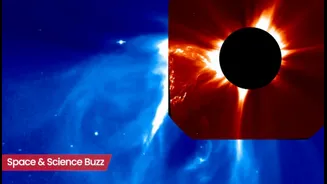
In a Rare Event, Solar Explosions Reach Earth in Just 25 Hours
A blistering coronal mass ejection (CME) from the Sun raced across 149 million
km of space in just 25 hours, smashing into Earth's magnetic field on January 19, 2026. This unprecedented speed dwarfs the typical 3-4 day journey most CMEs take, clocking in at around 1660 km/s, ranking it among the fastest observed in the past 30 years. The explosion from the Sun travelled at a staggering speed of 1,660 kilometres per second. The high-velocity plasma cloud, triggered by an X1.9-class solar flare from sunspot region AR4341 on January 18, caught forecasters off guard by arriving earlier than predicted. Upon impact, it unleashed a severe G4-class geomagnetic storm, as confirmed by Noaa's Space Weather Prediction Center. Such storms, the second-highest on the five-tier scale, disrupt satellites, power grids, and high-frequency radio communications while supercharging auroral displays.
A Delta in Danger: Why the Ganga-Brahmaputra Region Is Slowly Sinking

The Ganga-Brahmaputra delta, one of the world’s largest and most densely populated river deltas, is slowly sinking, and scientists warn this quiet geological shift could push nearly 23 crore people closer to a humanitarian and climate disaster. A new global study published in Nature has found that many major river deltas are subsiding, or sinking, at rates that match or even exceed global sea-level rise. The study shows that land subsidence in the Ganga-Brahmaputra delta is driven by a combination of natural processes and intense human activity. Deltas are built from soft sediments deposited by rivers over thousands of years. Over time, these sediments naturally compact and sink. But human actions are now accelerating the process.
Think Gluten Causes Weight Gain? Here’s the Real Reason Cutting It Works

Gluten is a naturally occurring protein found in grains such as wheat, barley, and rye, which means it's commonly consumed in everyday foods like bread, pasta, and cereal. For most people, gluten doesn't cause any health problems. But for those with celiac disease – which affects about 1% of people – avoiding it is essential. This autoimmune condition triggers an immune response to gluten, damaging the small intestine's lining, impairing nutrient absorption. Foods high in gluten, such as bread, pasta, and cereal, don't just provide carbohydrates, they're also excellent sources of fiber and B vitamins. Removing these foods may inadvertently contribute to nutrient deficiencies. Yet the market for gluten-free products continues to surge, with projections suggesting it will reach US$13.7 billion by 2030.
Scientists Confirm Final Disintegration of Iceberg A23a

A23a, once the world's largest iceberg, has entered the final stage of its disintegration. True-color images with 250-meter resolution captured on January 14 showed that the iceberg's main body has reduced to just 506 square kilometers, reported CGTN. According to the scientists, the iceberg has shrunk to less than one-eighth its initial size of 4,170 square kilometers when it broke away from the Antarctic ice shelf in 1986. A23a's disintegration has accelerated significantly in recent weeks. Just three weeks ago, its main body covered approximately 948 square kilometers, suggesting its rapid disintegration. The primary cause of this rapid breakup is hydrofracturing. This creates meltwater ponds and glacial lakes on the iceberg's surface, exerting immense pressure on the ice.