







A historic ceremony, a century-old mystery, and a question the world still loves to debate.
On December 10, 1901, the world witnessed a moment that quietly
changed the future of science, literature, and global peace; the first-ever Nobel Prize ceremony. Hosted in Stockholm, Sweden, it was the beginning of a tradition that would eventually honour some of the greatest minds of humanity, from Albert Einstein and Rabindranath Tagore to this year’s pioneers in AI ethics and climate biology.
But along with admiration, the Nobel legacy carries one mystery that refuses to fade:
Why is there no Nobel Prize for Mathematics?
For decades, students, academics, and curious readers have tried to decode this missing category. And as we look back at the world’s most respected award system in this year-end reflection, it’s time to dive deeper into facts, folklore, and the surprising truth behind this unanswered question.
A Short History of the First Nobel Ceremony
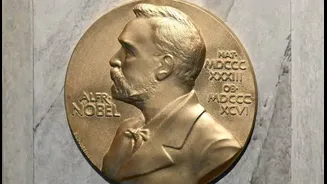
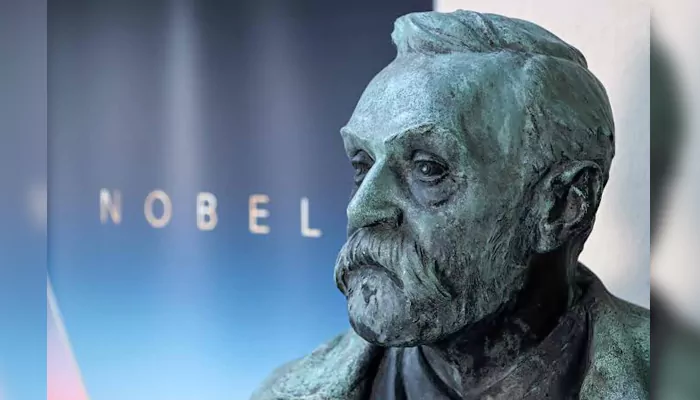
The Nobel Prizes were created according to the will of Alfred Nobel, the Swedish inventor best known for discovering dynamite. His final wish was simple yet revolutionary: use his wealth to honour those who “have conferred the greatest benefit to humankind.”
So, on this day in 1901, five prizes were distributed for the first time in Physics, Chemistry, Physiology or Medicine, Literature, and Peace
The world took notice. Newspapers across Europe celebrated this new benchmark of excellence. And 123 years later, the Nobel Prize remains the gold standard of global recognition.
But Why No Nobel Prize in Mathematics? The Myths, The Drama, The Truth
This question has led to everything from intellectual gossip to conspiracy theories. Let’s break it down.
Myth 1: Alfred Nobel Removed Math Because of a Love Triangle
A widely shared urban legend claims that Alfred Nobel refused to include mathematics because a mathematician, often said to be Gösta Mittag-Leffler, was romantically involved with Nobel’s alleged partner.
The truth?
There is no evidence Nobel had any such rivalry. Historians agree this theory is more fiction than fact, though it continues to survive because it’s too dramatic to ignore.
Myth 2: Nobel Didn’t Think Math Made a “Direct Societal Impact”
Some believe Nobel considered mathematics too theoretical, preferring inventions and contributions that had practical global benefit.
The truth?
This explanation is closer to reality. Nobel’s will repeatedly mentions benefiting humankind. He was drawn to discoveries that could be applied in real-world settings: medicine, peace, technology, and literature’s influence on society. Mathematics, at the time, was seen as a foundational science but not one with immediate human impact.
The Most Acceptable Explanation: There Was Already a Major Math Prize
During Nobel’s lifetime, the Royal Swedish Academy of Sciences already recognized mathematicians through the Acta Mathematica Prize. Some scholars believe Nobel simply didn’t feel the need to duplicate existing honours.
In short, he didn’t exclude math, he just didn’t include it because he thought the field was sufficiently covered.
Enter the “Nobel of Mathematics”: The Fields Medal
To fill the gap, the world later turned to the Fields Medal, established in 1936 and awarded every four years to mathematicians under 40.
It’s the highest honour in modern mathematics, prestigious, but not as universally recognized as the Nobel.
In 2025, India celebrated significant triumphs in mathematics research, and industry reports suggest a rising number of Indian mathematicians are now contributing to global breakthroughs in AI modelling, quantum computing, and algorithm optimization, fields closely tied to real-world impact, echoing Nobel’s original vision.
Why Does This Story Still Matter?
In a world transformed by AI, blockchain, space missions, and quantum research, the boundaries between mathematics and practical application have blurred like never before.
Math is no longer just equations, it’s the engine behind every major tech revolution.
India’s tech workforce reports show that mathematical modelling, data science fundamentals, and algorithm expertise have become some of the most in-demand skills of 2025. The irony? These are the very areas Nobel considered “too theoretical” in his time.
Had Nobel lived in the age of AI, perhaps we would have seen a Prize for Mathematics.