






Here are today’s most important updates from the realm of Science and Space.
Researchers Detect 'Potentially Habitable' Earth-Like Planet Candidate
Kepler Space Telescope, a mission which was designed to survey a portion of
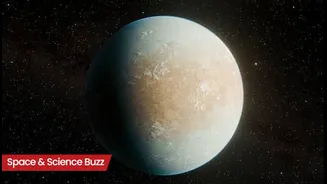
the Milky Way galaxy, retired in 2018, but its data continues to surprise the scientists. Recently, astronomers in Australia have identified a potentially habitable Earth-sized planet candidate, HD 137010 b. It is located approximately 150 light-years from Earth. This planet orbits a Sun-like star and is about six per cent larger than Earth, earning it the nickname "where Earth meets Mars" due to its size and distance from its host star. Although it is quite similar to Earth, scientists believe that it could be colder than perpetually frozen Mars. If confirmed, HD 137010 b would be the only known rocky world in the habitable zone of a Sun-like star, making it a significant discovery in the search for extraterrestrial life.
Study Warns: Asteroid Impact on Moon in 2032 May Affect Earth
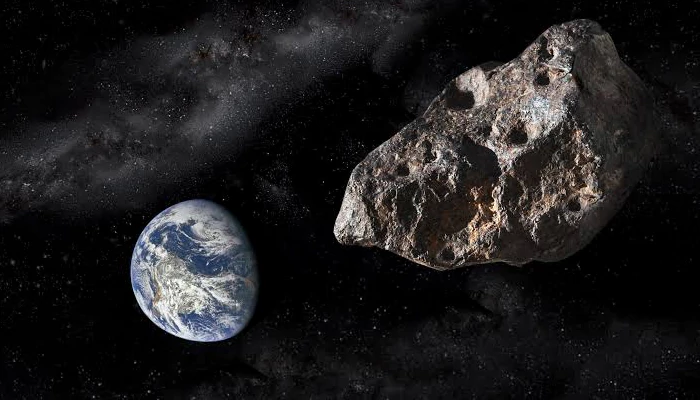
Scientists are closely watching a newly identified asteroid that could strike the Moon in December 2032, an event that may send debris towards Earth and pose risks to satellites - while also offering a rare scientific opportunity. Asteroid 2024 YR4, estimated to be about 60 metres wide, currently has a 4 percent chance of hitting the Moon on December 22, 2032. While the odds remain low, researchers say the impact would be powerful enough to attract global attention. If the asteroid hits, it is expected to carve a crater about one kilometre wide and trigger a global moonquake measuring roughly magnitude 5. This would provide valuable data on the Moon's internal structure, something scientists have struggled to study directly.
Scientists Uncover Previously Unknown Faults at Key US Seismic Zone

Scientists studying swarms of tiny earthquakes have uncovered hidden fault structures beneath Northern California, offering a clearer picture of one of the most complex and dangerous earthquake zones in the United States. The research focuses on the Mendocino Triple Junction, an area off the coast of Humboldt County where three major tectonic plates meet. This region links the San Andreas fault with the Cascadia subduction zone and has long puzzled scientists because its underground structure does not match what appears on surface maps. By analysing very small, low-frequency earthquakes-too weak to be felt by people-the team tracked how tectonic plates grind, slide, and sink beneath one another. These microquakes helped scientists map faults that are completely hidden underground.
MAVEN Spacecraft Silent Since December, NASA Makes Fresh Contact Attempt
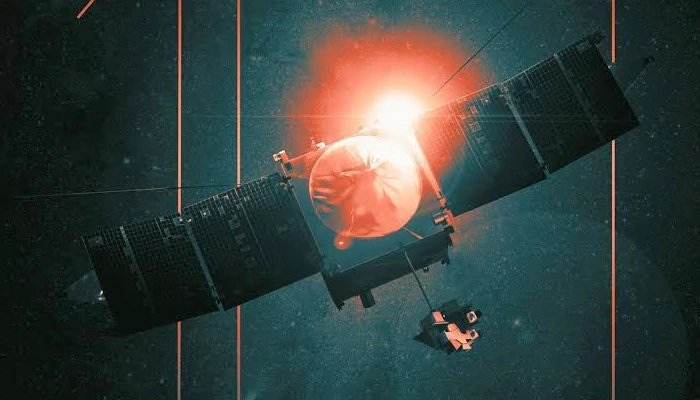
NASA has resumed attempts to reestablish contact with its Mars Atmosphere and Volatile Evolution (MAVEN) spacecraft, which was lost recently. The spacecraft has been silent since December 6, 2025. It was launched in November 2013, and since then, it studied Mars' upper atmosphere and its interaction with the solar wind. According to NASA, the spacecraft was last heard from on December 6. MAVEN's last communication indicated it was rotating unexpectedly and possibly deviating from its intended orbit. The exact cause is unknown, but possibilities include onboard computer failure, a stuck valve, or fuel shortage. The solar conjunction is a period when the Red Planet and Earth are on opposite sides of the Sun, and contact with Mars missions isn't possible.