





Here are today’s most important updates from the realm of Science and Space.
Solar Storm Strikes as Artemis II Prepares for Launch
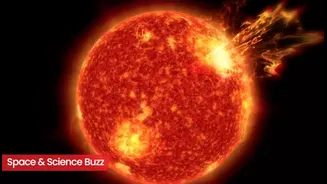
A powerful X-class solar flare has triggered a radio blackout, raising concerns
about the upcoming Artemis 2 mission scheduled to launch in April 2026, Space.com reported. The solar flare was unleashed by the sun in the early hours of Monday (March 30). According to NOAA's Space Weather Prediction Center, the flare peaked at 11:19 pm EDT (0319 GMT). It is reported that the flare, classified as X1.4, has the potential to disrupt satellite communications and navigation systems. As per the media outlet, the flare also launched a coronal mass ejection that could have an Earth-directed component, which might cause a geomagnetic storm, ultimately leading to auroras.
NASA Reveals What Astronauts Will Do During Lunar Journey

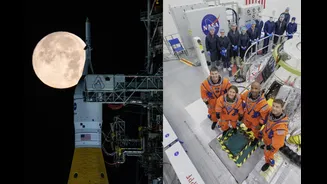
The Artemis II mission is not just a test flight; it is a homecoming. For the first time since the final Apollo mission in 1972, humanity is returning to the vicinity of the Moon. This 10-day mission will carry four astronauts farther into the deep space vacuum than any human has ever travelled. Beyond flying the ship, the crew will be incredibly busy with scientific and medical duties. Since Artemis II travels outside the protection of Earth’s magnetic field, the astronauts will serve as research subjects to study how deep space radiation affects the human body. They will use wearable devices to track their sleep patterns and stress levels, and even perform CPR demonstrations to prepare for medical emergencies in microgravity.
New Covid Variant ‘Cicada’ Detected: What We Know So Far
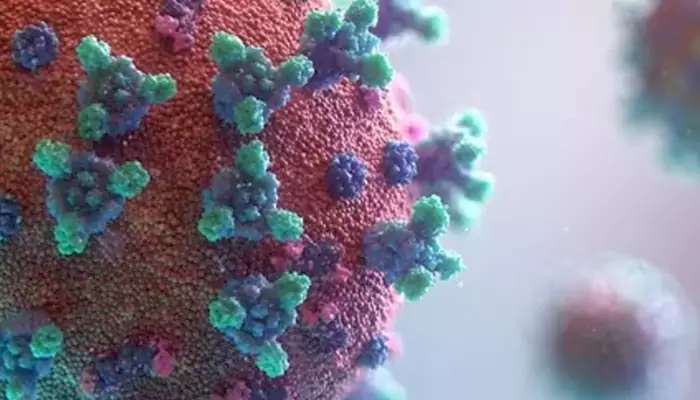
A newly identified Covid-19 variant, informally dubbed Cicada, has been detected in limited clusters across multiple regions, prompting scientists to closely monitor its characteristics, transmissibility, and potential impact. Early analyses suggest that while the variant carries a distinct set of mutations, there is currently no evidence to indicate it is more dangerous than previous strains, such as Delta or Omicron. Researchers studying the virus note that Cicada appears to have evolved from an Omicron sub-lineage, accumulating additional mutations primarily in the spike protein, the part of the virus that helps it enter human cells. Global health agencies and laboratories are currently conducting genomic sequencing and epidemiological studies to better understand how quickly Cicada spreads and whether it could outcompete existing variants.
Pune’s Rare Hail Event Explained: What Triggered the Storm

Parts of Maharashtra witnessed intense rainfall and hailstorms on Monday, bringing sudden relief from rising temperatures but also disrupting daily life in cities, including Pune. The abrupt change in weather is being attributed to evolving atmospheric conditions and moisture inflow over western India. According to meteorological assessments, cloudy skies have developed over Pune and the Western Ghats, with isolated rainfall activity expected to continue through the day. The region has seen localised hailstorms, often caused by strong updrafts within thunderclouds that carry raindrops into colder layers of the atmosphere where they freeze before falling as hail.