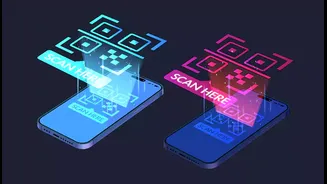

Barcodes, in their simplest form, are a series of black and white stripes arranged in a specific pattern.
In today’s fast-paced world, barcodes and QR codes are
everywhere. From retail stores and logistics to event tickets and even restaurant menus, these simple patterns have become an essential part of modern life. They might seem like a small part of the process, but behind the simplicity of these codes is a fascinating blend of science and technology that makes them incredibly efficient at storing and conveying information. Understanding how barcodes and QR codes work involves exploring the science behind the patterns, how data is encoded, and the systems that read and decode this information.
The Basics of Barcodes: A Glimpse into the Past
The idea behind barcodes was born in the early 1950s, with the goal of improving the accuracy and efficiency of inventory management in retail stores. These stripes are not just decorative; they encode data in the form of widths and spaces, which can be read by optical scanners.
The most common barcode format, the Universal Product Code (UPC), uses 12 digits to identify a product. The barcode scanner shines a light on the barcode, and the reflected light is analyzed by a sensor. The width of the black and white stripes, along with the spacing between them, provides information about the product. Essentially, the pattern of black lines represents numbers or letters that are decoded by a computer system into usable data, such as the price, manufacturer, and product details.
How Barcode Scanners Work
When a barcode scanner is aimed at a barcode, it emits a laser or LED light that illuminates the code. The reflected light is then detected by a sensor, which converts the light intensity into an electrical signal. The scanner interprets the different light patterns—dark bars reflect less light, while white spaces reflect more—by analyzing the variation in light intensity. The system then translates this variation into digital data that the computer can read and process.
The accuracy of barcode scanners is key to their success. These scanners rely on precise sensors and algorithms that are capable of detecting even small variations in light intensity, ensuring that the barcode’s information is correctly captured and translated. Today, barcode scanning technology has been refined and integrated into countless industries, providing faster and more accurate ways to manage inventory, track shipments, and facilitate checkouts.
QR Codes: The Next Generation of Codes
Quick Response (QR) codes are a more recent development in the world of barcodes. Unlike traditional barcodes, which are typically linear, QR codes are two-dimensional (2D) and can store significantly more data. This makes them more versatile, as they can store URLs, contact information, product details, and even payment information.
A QR code is made up of a matrix of black squares arranged on a white background. The arrangement of these squares represents binary data, which can then be decoded by a QR code reader. QR codes have become widespread due to their ability to hold more data than traditional barcodes, and they can be scanned from any angle, making them easier to use.

To read a QR code, a camera captures an image of the code, and special software decodes it by analyzing the pattern of black squares. The data encoded in the QR code can then be accessed instantly, whether it's a website URL, a payment request, or even a menu for a restaurant. This speed and ease of use have made QR codes an invaluable tool for businesses and consumers alike.
How QR Code Scanners Work
QR code scanners use image recognition technology to analyze the code. The camera takes a snapshot of the code, and the software identifies the position, size, and orientation of the squares. It then decodes the binary data by converting the square patterns into digital information. One of the key advantages of QR codes is that they can store much more data than traditional barcodes, thanks to their 2D structure.
QR codes can also be used for dynamic content, meaning that the information within the code can be updated in real-time. For instance, a QR code on a marketing flyer might lead to a specific promotional webpage. If the promotion changes, the URL embedded in the QR code can be updated without needing to change the code itself. This makes QR codes a flexible and efficient tool for businesses looking to engage with customers.
The Role of Data Encoding and Error Correction
Both barcodes and QR codes rely on precise data encoding and error correction to function properly. When information is encoded into these codes, it’s often translated into binary form, consisting of a series of 1s and 0s. This binary data is then converted into patterns that can be read by scanners. The information stored in the codes is often compressed to make it more efficient and compact.
One of the key innovations in QR codes, for example, is error correction. QR codes use a system called Reed-Solomon error correction, which allows the code to still be readable even if part of it is damaged. This is especially useful in environments where QR codes may be exposed to wear and tear, such as on shipping boxes or promotional materials. The higher the error correction level, the more data the QR code can withstand being obscured or damaged while still remaining scannable.
Barcodes and QR Codes in Everyday Life
Both barcodes and QR codes have become indispensable tools in modern society. Barcodes are commonly used in retail, inventory management, and supply chain operations, ensuring that products are easily identified, tracked, and sold. QR codes, on the other hand, have expanded beyond retail to encompass a wide range of applications, from mobile payments to contactless check-ins, providing quick access to digital content and services.