
Here are today’s most important updates from the realm of Science and Space.
Peering Inside the Northern Lights: NASA Plans Aurora ‘CT Scan’
NASA scientists to perform a CT scan of the auroras to get insight details
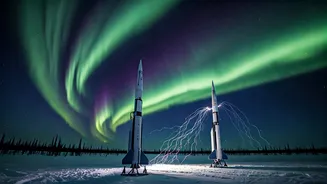
about these stunning 'dancing lights', which are formed when charged solar particles collide with gases in Earth's upper atmosphere, usually visible near the magnetic poles. The launch of the Geophysical Non-Equilibrium Ionospheric System Science (GNEISS) mission was scheduled to take place from Alaska's Poker Flat Research Range in February 2026. Auroras, also called the northern lights, are nothing but a giant cosmic electrical circuit, and the scientists want to study them by sending two rockets through them, with each deploying four sub-payloads. These payloads will transmit radio signals to ground receivers, acting like a CT scan to map the density and direction of electrons.
Eyes on the Skies: Will Comet Wierzchos Be Seen From India?
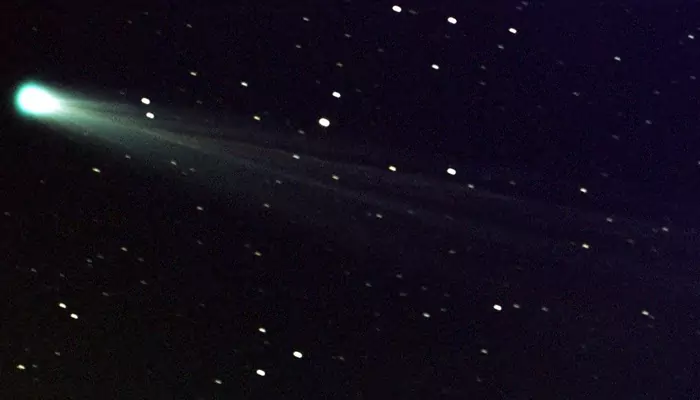
A new comet is moving across Earth's skies, giving astronomers and stargazers another chance to observe a visitor from the far reaches of the solar system. A Comet C/2024 E1 (Wierzchos) is making its way from the edge of the solar system into Earth's skies, according to reports. C/2024 E1 (Wierzchos) was discovered in March 2024 by astronomers studying data collected by the Catalina Sky Survey. This survey, operated by the University of Arizona with support from NASA, continuously monitors the night sky to identify potentially hazardous near-Earth objects. The celestial object will be visible in the southern hemisphere. However, those in the Northern Hemisphere will also get a chance to see C/2024 E1 (Wierzchos) in the coming weeks after its closest approach to Earth on February 17.
This Jelly-Like Robot Bends and Moves Like Real Tissue, UK Scientists Say

Researchers have unveiled a soft, jelly-like robot capable of shape-shifting and moving via external electric fields. This innovation eliminates the need for traditional motors, gears, or rigid joints, allowing the machine to navigate environments that are often inaccessible to standard robotics. In a recent video, a prototype humanoid "gymnast" demonstrated the ability to swing across surfaces using its flexible body. According to University of Bristol researcher Ciqun Xu, the robot's body acts as its own moving mechanism when electricity is applied. It generates stretching, bending, and twisting movements, allowing it to move.
The Secret Behind Auroras’ Stunning Wave Patterns, Scientists Reveal

Auroras, the northern lights (aurora borealis) or southern lights (aurora australis), are breathtaking displays of colored light in the night sky. Auroras are caused by intense solar storms that hit Earth's magnetic field. The displays can come in various forms, such as bands, rays, patches and more. But ever wondered how the beautiful patterns are formed? According to a new study published in Nature Communications, researchers have revealed the mystery behind a type of aurora called the auroral arcs. While detailing the entire process, the study noted that the Sun emits a stream of charged particles, known as the solar wind, which includes electrons and protons.