
Introduction
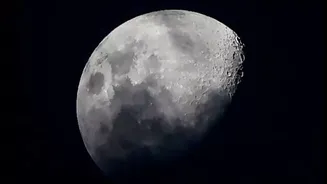
There’s something undeniably captivating about the sight of a full moon, especially when it appears unusually large and close in the night
sky. Many have witnessed what’s commonly known as the "supermoon," when the moon seems bigger and brighter than usual. This phenomenon has sparked intrigue and fascination throughout history, leading to myths, legends, and even modern-day curiosity. But why does the moon sometimes appear larger on certain nights? The science behind this celestial event is a blend of optical illusions, the moon's orbit, and its position relative to Earth. In this article, we explore the reasons behind the moon's varying size in the night sky, from its elliptical orbit to the human perception that amplifies its size.
The Moon’s Orbit: Why It Varies in Size
The moon’s apparent size in the sky is influenced by its orbit around Earth. The moon doesn’t travel in a perfect circle but rather follows an elliptical (oval-shaped) orbit. As a result, there are times when the moon is closer to Earth and times when it is farther away. The closest point in its orbit is called the perigee, and the farthest point is called the apogee.
When the moon is at perigee, it is about 30,000 miles (48,000 kilometers) closer to Earth than when it is at apogee. This closer proximity causes the moon to appear about 14% larger and 30% brighter in the sky compared to when it is at its farthest point. This phenomenon is known as a supermoon, and while the difference in size might seem dramatic, it's not as noticeable to the naked eye unless the moon is viewed alongside objects of known size, such as trees or buildings.

The Illusion of the "Moon Illusion"
While a supermoon is a real phenomenon, there is another optical illusion that makes the moon appear larger on the horizon. This effect, known as the moon illusion, occurs when the moon is low in the sky near the horizon. Even though the size of the moon remains constant, it seems much larger when viewed in this position compared to when it is high in the sky.
The exact cause of the moon illusion is still debated, but there are a few popular theories that attempt to explain it. One theory is that when the moon is near the horizon, we compare its size to familiar objects on the Earth’s surface, like trees, buildings, or mountains. These reference points create a sense of scale, making the moon appear much larger. When the moon is higher in the sky, there are no such objects for comparison, so it appears smaller.
Another theory suggests that the atmosphere plays a role. The atmospheric distortion near the horizon, caused by the thicker layer of air between the observer and the moon, can stretch the moon’s image vertically, making it appear larger. However, this distortion likely doesn’t account for the entire effect, as the moon retains its spherical shape despite the stretching.
The Role of Earth's Tilt and Seasons
The position of the moon in the sky also changes with the seasons, influenced by Earth's axial tilt. As Earth orbits the Sun, the angle of sunlight hitting the planet shifts, causing the moon to appear at different points in the sky throughout the year. During certain times of the year, the moon may rise at a higher or lower angle in the sky, which can amplify the effect of the moon illusion.
When the moon rises during the early evening or sets during the morning, it can appear particularly large, especially during the colder months when the atmosphere tends to be clearer. The crisp, clear air and lower humidity can enhance the visibility of the moon near the horizon, making it appear even more striking.
The Supermoon Phenomenon: When Does It Occur?
A supermoon occurs when a full moon coincides with the moon being at or near its perigee. While the technical definition of a supermoon requires that the moon be within 90% of its closest approach to Earth, the term has become widely used to describe any moon that appears particularly large in the sky. Supermoons occur several times a year, though they are not always visible in all parts of the world due to weather conditions, geography, or local time zones.
On average, supermoons appear approximately three to four times a year. However, the largest supermoons, where the difference in size and brightness is most noticeable, occur less frequently. These rare occurrences can make the moon appear especially breathtaking, and astronomers and skywatchers often recommend that people take the time to witness these events, as they offer an extraordinary view of Earth’s closest celestial neighbor.
Why the Moon Looks Bigger in Photographs
It’s not just the human eye that can be deceived by the moon’s apparent size. Photographs and videos often capture the moon as larger than it appears in person. This is because cameras tend to compress the perspective of the scene, making objects closer to the camera appear larger in comparison to objects farther away. When the moon is near the horizon, it may be photographed alongside trees, buildings, or other landmarks, which can create the illusion of a much larger moon. However, this effect is a trick of perspective, not an actual increase in the moon’s size.
The Emotional Impact of a Big Moon
Beyond the science, the sight of a large moon has an emotional and cultural significance for many people. The moon has long been a symbol of mystery, romance, and beauty, often linked to folklore, art, and poetry. The appearance of a particularly large moon can evoke a sense of awe and wonder, reminding us of the vastness of the universe and our connection to the cosmos. Whether it’s the ethereal glow of a supermoon or the breathtaking rise of the moon near the horizon, these moments of cosmic beauty often leave us with a sense of amazement.
Conclusion
The moon’s appearance as a larger-than-usual object in the sky can be explained by a combination of astronomical phenomena and visual illusions. From the moon’s elliptical orbit and its perigee to the optical effects that occur when the moon is near the horizon, the science behind the moon’s varying size is rooted in both the physical world and human perception. While the supermoon offers a real increase in the moon’s size and brightness, the moon illusion and other visual effects make it seem even more dramatic at times. Whether driven by science or the beauty of nature, the moon continues to captivate and intrigue, with each appearance offering a new experience for those who look up.