
Here are today’s most important updates from the realm of Science and Space.
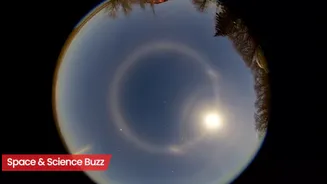
Moon Wrapped in Ghostly Ring Over Canada: The Science Behind the Spectacle
Residents of southern Manitoba were treated to an extraordinary sight when
a huge, ghostly ring of light encircled the night sky. The strange halo appeared on December 3 over the town of Kaleida. The formation, known as a lunar parhelic circle, is among the rarest atmospheric displays. It occurs when moonlight reflects off countless tiny hexagonal ice crystals suspended in the upper atmosphere. Under the right conditions, cold temperatures, clear skies, and abundant ice crystals, the reflected light forms a faint, continuous ring that circles the entire sky at the same altitude as the Moon.
Scientists Catch Mysterious ‘UFO’ Near Black Hole in Once-in-History Event
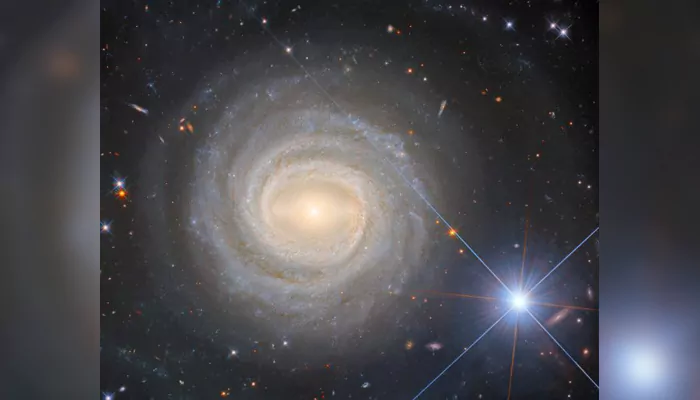
For the first time, astronomers have caught the moment when a supermassive black hole flare triggers a mighty wind blasting out into space at relativistic speeds. The so-called ultrafast outflow, or UFO, was recorded reaching speeds 19 percent of the speed of light in a vacuum, about 57,000 kilometers (35,400 miles) per second. That's not the fastest such outflow ever recorded, but it is the first observation of the onset and evolution of the supermassive black hole flare and the UFO it unleashed. The galaxy NGC 3783 is a beautiful barred spiral galaxy located about 130 million light-years away, oriented with its broadside directly facing Earth, giving us a perfect view of the active supermassive black hole at its center.
Space Training Shocker: The Real Reason Astronauts Practice Helicopter Crash Escapes
My highlight of the week: helicopter-under water escape training 🌊🚁
— Alexander Gerst (@Astro_Alex) December 8, 2025
After returning from space, astronauts typically land with their spacecraft in the ocean. We are retrieved by an incredible team of Flight Surgeons and Crew Support Officers, who pick us up by helicopter and… pic.twitter.com/EzIcMZEqGF
(Credit: X/@Astro_Alex)
Astronauts face a unique set of challenges after returning from space, particularly during ocean recovery operations. Alexander Gerst, a European Space Agency (ESA) astronaut, recently shared insights into a demanding aspect of their training, learning to escape a helicopter that has crashed and capsized in water. After landing in the ocean, returning astronauts are typically retrieved by a team that includes Flight Surgeons and Crew Support Officers. These specialised teams use helicopters to transport astronauts safely back to land. However, the possibility of a helicopter accident during this transfer means all members must be prepared for emergencies. Training for an overturned helicopter scenario is not limited to astronauts but includes the entire recovery crew. In the event of an emergency water landing, there is a narrow window for escape since helicopters are top-heavy and can quickly overturn and sink. This risk necessitates thorough preparedness for all involved in recovery missions.
Skip a Few Bites, Save Your Brain? Diet Study Reveals Surprising Benefits

A calorie-restricted diet could slow down the aging that naturally happens in the brain as we get older, according to a new study of rhesus monkeys, and the findings could also be relevant to brain diseases such as Alzheimer's. By giving the body less fuel to work with, these diets can put the body's metabolism into a more efficient mode – which, in this study, appears to have protected against some of the cellular wear and tear that normally comes with aging. This study provides rare, long-term evidence that calorie restriction may also protect against brain aging in more complex species.