
Here are today’s most important updates from the realm of Science and Space.
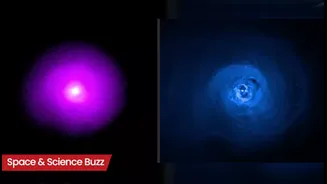
A Long Look Into Darkness: NASA Solves How Black Hole Jets Really Work
An international team of astronomers using NASA’s IXPE (Imaging X-ray Polarimetry
Explorer) has identified the origin of X-rays in a supermassive black hole’s jet, answering a question that has been unresolved since the earliest days of X-ray astronomy. The IXPE mission observed the Perseus Cluster, the brightest galaxy cluster observable in X-rays, for more than 600 hours over a 60-day period between January and March. Not only is this IXPE’s longest observation of a single target to date, it also marks IXPE’s first time observing a galaxy cluster. Polarization measurements from IXPE carry information about the orientation and alignment of emitted X-ray light waves. The more X-ray waves traveling in sync, the higher the degree of polarization.
Before Galaxies Took Shape, ‘Dinosaur Stars’ Ruled the Cosmos, Webb Suggests
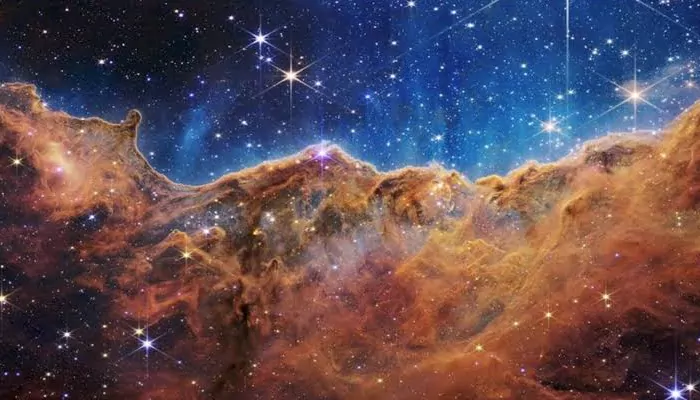
Using the James Webb Space Telescope, astronomers may have found the first real signs of giant, dinosaur-like stars that lived shortly after the Big Bang. These stars were not like the ones we see today. Scientists believe they were extremely massive, with some weighing up to 10,000 times more than our sun. Just like dinosaurs on Earth, these stars no longer exist. However, they left behind clues that scientists can still detect today, according to reports. These ancient stars are special because they help us understand how supermassive black holes formed so quickly in the early universe. At that time, when the universe was less than a billion years old, some black holes were already millions of times the mass of the Sun. For a long time, scientists remained a mystery as to how this process happened so quickly.
Microscopic Marvels: Scientists Build Thinking, Healing Robots Smaller Than a Grain of Sand

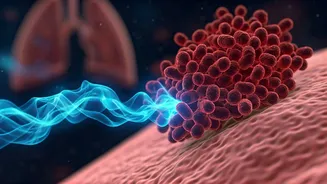
Scientists at the University of Pennsylvania, in collaboration with the University of Michigan, have developed the world's smallest fully programmable and autonomous robots. These micro-swimmers, about the size of microorganisms (0.2 x 0.3 x 0.05 millimetres), can move independently, sense their environment, and respond to changes, all while costing only a penny each. Powered by light and guided by a micro "brain" developed at Michigan, the robots can perform tasks like sensing temperature and adjusting their movement patterns. Supported by the National Science Foundation, this innovation could significantly impact medicine by monitoring cell-level health and aid in building tiny, precise devices in manufacturing.
Peering Into Cosmic Nothingness: Roman Telescope Takes Aim at Dark Energy
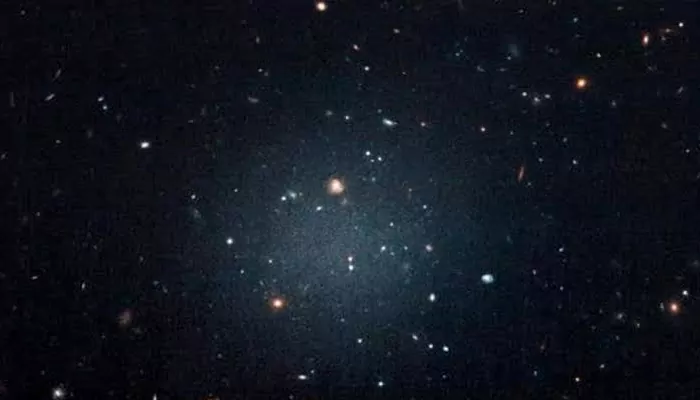
Our universe is vast, filled with galaxies stretching in every direction as far as telescopes can see. Some scientists estimate there could be as many as two trillion galaxies in the observable universe. While these galaxies may look randomly scattered, they are actually arranged along the surfaces of enormous cosmic "bubbles," some spanning hundreds of millions of light-years. The empty spaces inside these bubbles, where very few galaxies exist, are called cosmic voids. NASA's Nancy Grace Roman Space Telescope will help measure these voids with unprecedented accuracy, offering new insights into the universe's expansion, reported NASA. These voids, which contain very little matter, are governed by dark energy, which helps the universe expand rapidly. Alice Pisani of CNRS and Princeton University said that studying vo