
Here are today’s most important updates from the realm of Science and Space.
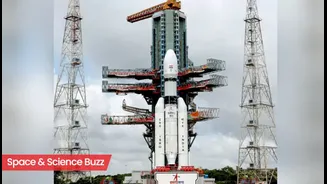
Space Diplomacy in Action: India’s Baahubali Rocket to Launch US Satellite
Space and atomic energy technology are closely guarded, and in the past Indo-US
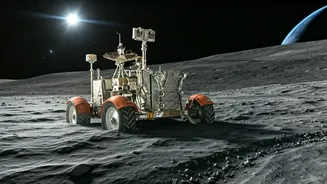
relations have swung like a pendulum in both these sectors, but now the world's oldest democracy and the world's largest democracy are showing signs of tangoing together in a new Indo-US strategic and commercial embrace. In a new milestone, the nuclear energy sector was opened up for American companies on December 18, but interestingly, the immediate fallout is possibly being witnessed in another strategic area: the space sector. An American communications satellite initially slated for launch on December 15 was delayed and is now being launched on December 24, 2025, soon after the enabling legislation that opens the door for private companies to invest in atomic energy was rushed through the Parliament.
Einstein Was Right Again: Black Hole Seen Bending Space While Devouring a Star
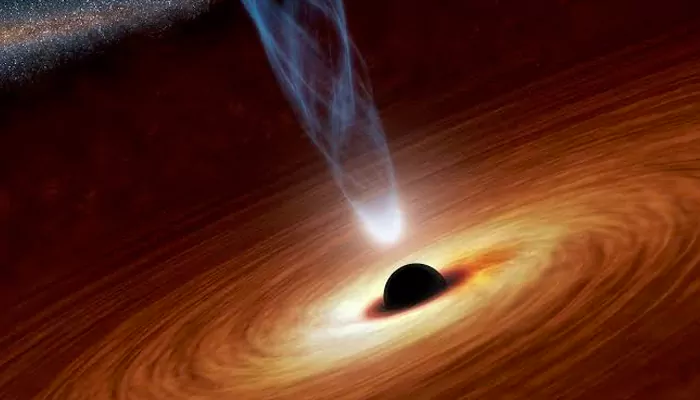
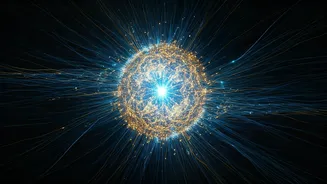
Astronomers have witnessed a rare and powerful event in space where a star is being ripped apart by a supermassive black hole while wobbling in its orbit. This wobble has given scientists clear evidence of a phenomenon known as Lense-Thirring precession, also called frame dragging. In this effect, a fast-spinning black hole pulls and twists space and time around itself as it rotates. The observation not only supports a key prediction made over a century ago but also opens a new window into understanding how black holes behave, according to reports. The concept of massive objects' effects on space and time stems from Albert Einstein's theory of general relativity, presented in 1915. According to this theory, massive objects bend space and time, and this bending is felt as gravity. The greater the mass of an object, the stronger its effect on space-time.
For the First Time Ever, NASA Sees Asteroids Crashing Around Another Star
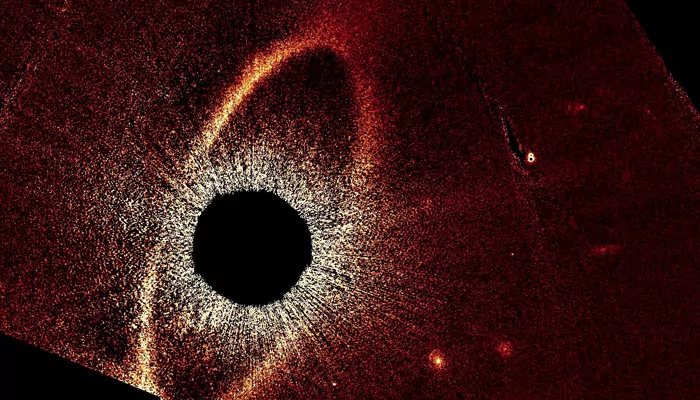
In a spectacular glimpse into the violent early days of planetary systems, NASA's Hubble Space Telescope has captured images of catastrophic collisions in a star system beyond our own. According to NASA, the observations show two massive debris clouds forming around the bright star Fomalhaut, 25 light-years from Earth, offering a rare look at the chaos that shaped planets billions of years ago. Astronomers believe the solar system's early days were a cosmic bumper-to-bumper, with planetesimals, asteroids, and comets colliding and pelting Earth, the Moon, and other inner planets with debris.
Nature’s Benjamin Button: Jellyfish That Turns Back Time Amazes Scientists
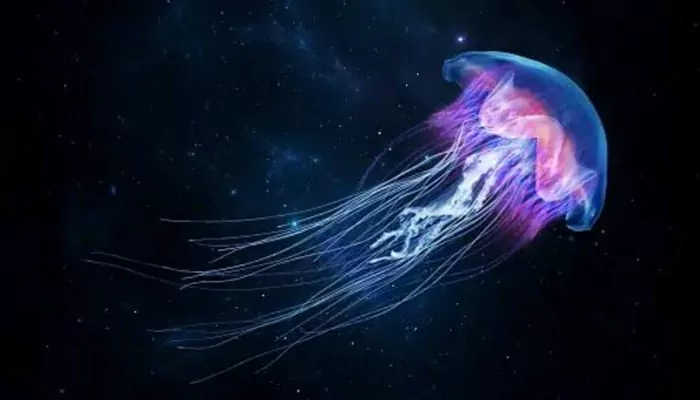
An unusual jellyfish found in tropical oceans has amazed scientists because it can reverse its own life cycle and avoid death. This rare ability allows the creature to return to an earlier stage of life instead of dying, making it one of the most fascinating animals in the ocean, according to reports. The jellyfish is called Turritopsis dohrnii. It was first discovered in 1883, but scientists learned about its special power nearly 100 years later. Researchers found that this jellyfish can rejuvenate itself and survive environmental and physical stress. Turritopsis dohrnii, also known as T. dohrnii, belongs to the hydrozoan family. Hydrozoans are part of the large group of aquatic invertebrates called cnidarians and are considered to be closely related to true jellyfish. Although they resemble jellyfish, their structure is different. The famous Portuguese Man o' War also belongs to this hydrozoan family.