


Your Brain on Sharp Objects
Before we get to the curves, we have to understand why the straight lines and sharp angles of traditional offices can be so grating. It turns out our brains are hardwired with a primal bias. Sharp, angular objects trigger a subconscious sense of threat
in the amygdala, the part of the brain that processes fear. Think about it from an evolutionary standpoint: sharp things in nature—thorns, jagged rocks, predators' teeth—were dangerous. Even if we’re consciously aware that the corner of a desk won't attack us, a part of our brain remains subtly on alert. A 2006 study by neuroscientists Moshe Bar and Maital Neta confirmed this, showing that people have a consistent and powerful preference for objects with curved contours over those with sharp points. When surrounded by an environment filled with these micro-threats—from the 90-degree angle of a computer monitor to the rigid grid of a ceiling—our nervous system can be in a constant, low-grade state of vigilance. This isn't just uncomfortable; it’s mentally draining, contributing to the background noise of workplace stress.
The Soothing Power of the Arc
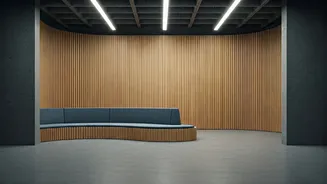
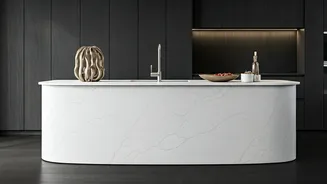
If sharp angles signal danger, curves signal the opposite: safety, comfort, and nature. This is the core principle of biophilic design, an architectural approach that seeks to connect us with the natural world. Nature rarely moves in straight lines. Think of rolling hills, flowing rivers, the shape of a flower petal, or the arc of the sun. Our brains associate these organic shapes with life and tranquility. When architects and designers introduce curves into a workspace, they are essentially speaking to our subconscious in a language it understands. The effect is often immediate. Walking into a room with a curved wall, a circular seating area, or a winding pathway feels different. It’s more inviting and less confrontational. The eye flows smoothly over a curved surface, requiring less cognitive effort to process than a series of abrupt angles. This visual fluidity creates a psychological sense of ease, allowing employees to lower their guard and feel more relaxed in their surroundings. The environment shifts from a place of rigid structure to one of gentle flow.
From Theory to the Real World
This isn't just a fringe design theory; it's being put into practice at some of the world's most innovative companies. The most famous example is Apple Park in Cupertino, California, a massive, perfectly circular building often called "the spaceship." Its endless curves are not just an aesthetic choice but a deliberate effort to foster movement, collaboration, and a connection to the central parkland. Similarly, Amazon's Spheres in Seattle are giant, glass-domed greenhouses filled with curved walkways and rounded plant beds, designed to give employees a restorative, nature-filled space to work and think. But you don’t need a billion-dollar budget to harness this principle. The trend is scaling down to everyday office interiors. We're seeing it in kidney-bean-shaped desks that encourage team huddles, arched doorways that soften transitions between rooms, and plush, rounded sofas that invite informal conversation. Even something as simple as replacing a rectangular conference table with a circular one can change the dynamic of a meeting, removing the subtle power play of a “head of the table” and creating a more egalitarian, collaborative atmosphere.
An Investment in Well-Being
Ultimately, the move toward curves is part of a larger shift in how companies view their physical space. For decades, the office was designed for maximum efficiency, often at the expense of human experience. The result was sterile, stressful environments that inadvertently contributed to burnout and disengagement. Today, smart leaders understand that an office is not just a place to house workers; it's a tool for fostering culture, creativity, and well-being. By softening the hard edges of corporate life, companies are making a tangible investment in their employees' mental health. A less stressful environment leads to more focused, creative, and productive people. While a curved wall won't solve all the pressures of a demanding job, it creates a supportive backdrop that helps people feel safer, calmer, and more at ease. It’s a powerful acknowledgment that the way a place feels matters just as much as how it functions.