







Beyond the Postcard Paradise
For most American travelers, the Andaman and Nicobar Islands—a remote Indian archipelago in the Bay of Bengal—represent the ultimate tropical escape. Days here are defined by brilliant sunshine, the shade of coconut palms, and the impossibly clear water
that laps against shores like Radhanagar Beach, often cited as one of the best in Asia. It’s a world of vibrant coral reefs, lush jungle, and a pace of life that forces you to slow down. You snorkel, you swim, you read a book in a hammock. It’s perfect. But this daytime perfection is only half the story. When dusk settles and the tourist crowds retreat from the beaches, the islands don't just go to sleep. Instead, they prepare for a secret light show, one that requires no electricity and is best viewed from the quiet intimacy of a kayak on the calm, dark sea.
Pushing Off Into the Darkness
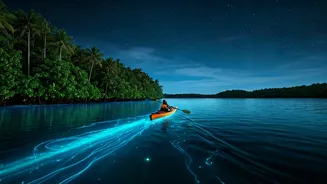
The experience begins on a quiet shoreline, often near the mangrove forests of Havelock Island (now officially Swaraj Dweep). With a guide, you step into your kayak as the last vestiges of twilight fade from the sky. The air, thick and warm during the day, feels cooler, fresher. The first few paddle strokes are tentative, pushing you away from the familiar comfort of land and into an inky expanse. There’s no engine noise, no music, just the rhythmic dip and splash of your paddle and the gentle lapping of water against the hull. Your eyes slowly adjust, trading the sun-drenched spectrum of the day for a world painted in silhouettes and shadows. The familiar shapes of the jungle coastline become a dark, mysterious wall. Above, without the light pollution of a major city, the stars blaze with an intensity rarely seen. It’s peaceful, slightly unnerving, and deeply immersive. You feel acutely aware of your place: a tiny vessel floating between a sea of stars above and an unseen world below.
The Ocean's Living Light
And then, you see it. At first, it’s a faint sparkle as your paddle disturbs the water. You dip your hand in, and a ghostly, blue-green light trails from your fingertips like fairy dust. This is the magic the headline promises: bioluminescence. The water is alive with millions of microscopic phytoplankton that emit light when agitated. Every paddle stroke creates a swirling galaxy of light. Fish darting beneath your kayak become living comets, leaving fleeting, phosphorescent trails in their wake. On a moonless night, the effect is breathtaking. The boundary between the water and the air seems to dissolve. You’re not just floating on the ocean; you’re paddling through a liquid constellation. Dragging your paddle creates a brilliant slash of light, while the wake behind your kayak glows like a phantom tail. It’s a silent, natural spectacle that feels more like a special effect from the movie *Avatar* than something that happens on Earth.
Finding a Deeper Silence
Beyond the stunning visuals, night kayaking offers a different kind of sensory experience. The Andamans by day are tranquil, but they are not silent. There’s the buzz of scooters, the chatter of beachgoers, the distant hum of long-tail boats. At night, all of that fades away. The silence is profound, broken only by the sounds of nature. You might hear the chirping of insects from the mangroves, the call of a nocturnal bird, or the startling splash of a fish jumping nearby. This auditory minimalism sharpens your focus, making the visual display of the bioluminescence feel even more miraculous. It’s a meditative experience, stripping away the distractions of modern life and connecting you directly to the natural world in its purest form.