




1. Master the Rule of Scale
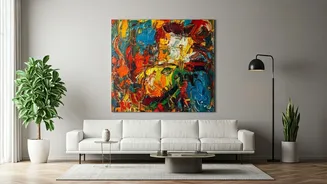
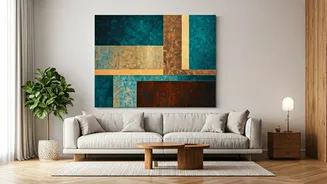
The first question is always, "How big is 'oversized'?" While there's no single measurement, a good rule of thumb is that the piece should occupy at least two-thirds of the wall space above the furniture it hangs over. For a standard 84-inch sofa, you're
looking for art that is at least 56 inches wide. If you’re hanging a piece on an empty wall, it should be substantial enough to command attention without being crowded by the room's dimensions. The goal is to be intentional, not accidental. A piece that is just slightly too small will look like a mistake. A piece that is dramatically large, however, looks like a confident choice. This confidence is what transforms the room from boring to bold.
2. Choose Your Hero Wall
Not every wall is suited for a large-scale statement. The ideal location is a natural focal point where the eye is already drawn. The wall behind your living room sofa is a classic for a reason—it anchors the primary seating area. Other prime spots include the wall behind your bed’s headboard, the main wall in your dining room, or at the end of a long hallway to create a dramatic destination. Avoid placing large art on a wall that's already busy with windows, doorways, or complex shelving. The power of oversized art comes from its ability to dominate a space with minimal competition. Give it room to breathe, and it will give your room a new center of gravity.
3. Let the Art Set the Tone
A large piece of art doesn't just fill a wall; it establishes the room's entire mood. Want a serene, calming retreat? A massive, soft-hued abstract painting or a sweeping landscape photograph can achieve that instantly. Looking for energy and dynamism? A vibrant, graphic piece with bold colors or chaotic brushstrokes will inject life into the space. Black-and-white photography, when scaled up, feels sophisticated and timeless. Even a massive canvas with a single, minimalist shape can feel architectural and profound. Instead of trying to find art that 'matches' your room, think about the feeling you want to create and choose a piece that delivers that emotional punch.
4. Create a Cohesive Color Story
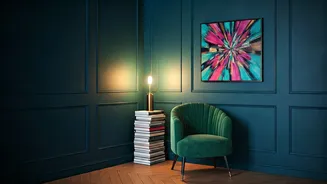
Once your statement piece is up, it becomes the roadmap for the rest of your room's accents. This is the easiest trick in the interior design playbook. Pull two or three accent colors from the artwork and repeat them in smaller doses around the room. A flash of yellow in the painting can be echoed in a throw pillow. A deep navy hue can be picked up in a vase or a decorative tray. This technique makes the art feel integrated and intentional, tying the entire space together without being overly coordinated. The art is the star, and the smaller decor items are the supporting cast.
5. Think Beyond the Frame
Oversized art doesn't have to be a single, expensive painting. Get creative with what constitutes a 'statement piece.' A large, beautifully woven textile or tapestry can add softness, texture, and sound-dampening qualities. A triptych—a set of three coordinating panels—can fill a wide space with more flexibility than a single massive frame. High-resolution digital prints have made large-scale photography more accessible than ever. You can even find downloadable art online and have it printed at a local shop for a fraction of the cost of a gallery piece. The impact comes from the scale, not necessarily the medium.