






More Than Just a Summer Shower
For many parts of the United States, especially the Southwest during its 'monsoon' season, summer storms aren’t gentle drizzles. They are powerful, unpredictable events bringing torrential rain, flash floods, intense lightning, and high winds. While other
regions might call it hurricane season or tornado alley's tempestuous summers, the outcome is often the same: a vulnerable power grid. A single lightning strike or a downed tree limb is all it takes to plunge a neighborhood into darkness for hours, or even days. This isn't just an inconvenience; it’s a disruption of modern life’s central nervous system. Without electricity, we lose light, refrigeration, and air conditioning. But most critically in the immediate moments of a storm, we lose our primary connection to the outside world—our digital devices. That’s where the definition of a 'smart' accessory begins to shift from convenience to necessity.
Your Phone: The Modern-Day Survival Tool
It’s easy to dismiss our reliance on smartphones as a trivial habit. But during a severe weather event, your phone transforms from a social media machine into an indispensable survival tool. It’s your flashlight, your emergency radio, your source for real-time weather alerts from the National Weather Service, and your map for potential evacuation routes. It’s how you check on family, let loved ones know you’re safe, and call for help if needed.
Without power, this digital multi-tool is just a useless slab of glass and metal. A dead phone during a power outage creates a profound sense of isolation and uncertainty. You can’t get updates, you can’t make calls, and you’re cut off from the information you need to make safe decisions. This is the problem that a simple, often-overlooked gadget is perfectly designed to solve.
Enter the Unsung Hero: The Power Bank
In a home preparedness kit, items like flashlights, batteries, and canned goods are classics for a reason. But a high-capacity power bank is arguably the most critical modern addition. Why? Because it doesn’t just do one thing; it powers the device that does *everything*. A dedicated flashlight is great, but your phone’s flashlight works just as well—as long as it has power. A weather radio is smart, but apps on your phone provide more specific, localized, and up-to-the-minute alerts.
A portable charger ensures that your most versatile tool remains functional when you need it most. It’s a small, self-contained power grid in the palm of your hand. For less than the cost of a nice dinner out, you can buy enough portable power to charge a smartphone multiple times over, keeping your lifeline open through a prolonged outage. Compared to a loud, fuel-dependent generator, a silent, compact power bank is the perfect immediate-response solution for personal devices.
Choosing Your Storm-Ready Sidekick
Not all power banks are created equal, especially when you’re relying on them for safety. When shopping for one to add to your emergency kit, focus on a few key features. First, capacity, measured in milliampere-hours (mAh). A 10,000mAh model is a good starting point, capable of charging a standard smartphone two to three times. For family needs or longer outages, a 20,000mAh or larger unit is a wise investment.
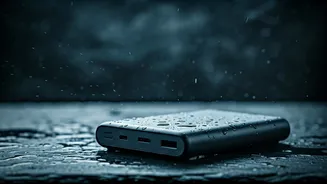
Next, look at the ports. Multiple USB outputs (including a USB-C port for faster charging) allow you to power up more than one device at a time. Finally, consider durability. While you don’t necessarily need a military-grade brick, models with some level of water and dust resistance offer extra peace of mind. Some even come with built-in LED flashlights or solar panels for trickle-charging in a multi-day outage, making them even more valuable when the lights are out for good.