







The Pre-Storm Checkup
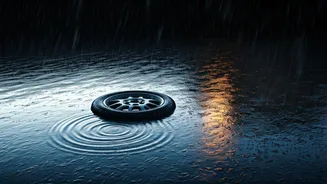
Preparedness starts before you even turn the key. The most critical components for wet-weather driving are the ones that connect you to the road and keep your vision clear. First, check your tires. Worn treads can’t channel water away effectively, leading
to hydroplaning, where your car essentially skis on a thin layer of water with no steering or braking control. Use the penny test: place a penny head-down in the tread. If you can see all of Abraham Lincoln’s head, your tires are worn and need replacement. Next, inspect your windshield wipers. Brittle, cracked, or streaky wipers are a safety hazard. They’re inexpensive to replace and essential for visibility in a downpour. Finally, do a quick walk-around to ensure all your lights—headlights, taillights, and turn signals—are working. In low-visibility conditions, being seen is as important as seeing.
Know the Danger: Understanding Water's Power
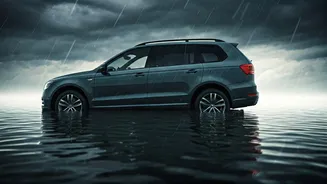
The single most important rule of driving in flood conditions is championed by the National Weather Service: “Turn Around, Don't Drown.” It’s not just a catchy phrase; it's a life-saving directive based on stark physics. It takes just six inches of water to reach the bottom of most passenger cars, potentially causing loss of control and stalling. At twelve inches, many cars can begin to float. Once floating, a vehicle becomes a boat with no rudder, easily swept away by moving water. Two feet of rushing water can carry away most vehicles, including SUVs and pickups. It’s impossible to judge the depth of murky floodwater or know if the road beneath has been washed away. The safest course of action is always to find an alternate route.
On the Road: How to Navigate a Deluge
If you are caught in a sudden, heavy downpour, your driving style needs to change immediately. First, slow down significantly. Posted speed limits are for ideal, dry conditions. Reducing your speed gives your tires more time to channel water and helps prevent hydroplaning. Second, disable cruise control. You need to be in complete command of your speed and braking, and cruise control can be slow to react to a sudden loss of traction. Increase your following distance to at least double the norm; braking takes longer on wet pavement. If you must drive through a stretch of standing water, do so slowly and steadily. Driving too fast creates a bow wave that can swamp your engine bay. After exiting the water, gently tap your brakes a few times to help dry the rotors and pads, ensuring they’re ready to function properly.
What to Do If Your Car Stalls
Stalling in rising water is a terrifying and dangerous situation. The first instinct—to restart the engine—is the worst thing you can do. If water has entered the engine's air intake, attempting to restart it can cause what's known as hydrostatic lock, where the engine’s internal components are forced against incompressible water. This can bend piston rods and destroy the engine, leading to thousands of dollars in repairs. Instead, put your hazard lights on, assess the situation, and prepare to abandon the vehicle. If the water is stationary and not rising, call for a tow. If it's rising or moving, get out immediately and move to higher ground. A car can be replaced; you cannot.
The Aftermath: Post-Puddle Inspection
Even if you make it through a deep puddle without stalling, your car isn’t necessarily in the clear. Water can compromise several systems. After driving through significant water, you should have your vehicle inspected. Mechanics will check for water contamination in fluids like the engine oil, transmission fluid, and differential fluid. Water can turn these lubricants into a useless, damaging sludge. They will also inspect the electrical system for corrosion or short-circuits and check the brake system for any lingering moisture or damage. Don't assume that because the car is running, it's fine. Hidden water damage can lead to catastrophic failure days or weeks later.