
Welcome to the Wettest Place on Earth
Tucked away in the northeastern corner of India, Meghalaya translates to “The Abode of the Clouds,” and it’s a name earned every single day. This state is home to two of the wettest places on the planet, the villages of Mawsynram and Cherrapunji, which
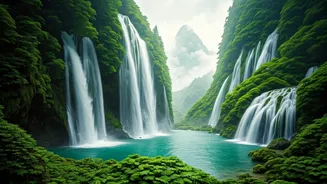
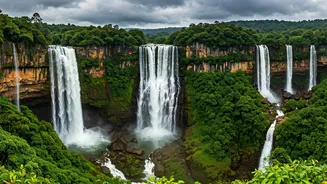
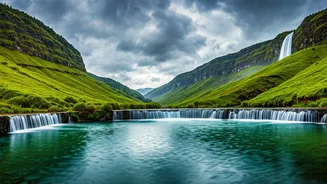
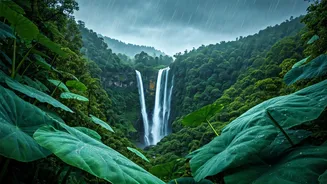
receive more rainfall in a year than many U.S. cities see in a decade. From roughly June to October, the Indian monsoon sweeps in from the Bay of Bengal, and the unique funnel-like topography of the Khasi Hills forces this moisture upward. The result is a near-constant deluge that replenishes, rejuvenates, and unleashes the region's most breathtaking feature: its waterfalls. During these months, trickles become torrents, and dry cliffsides weep with hundreds of newly-formed cataracts, creating a soundscape of rushing water that fills every valley.
Nohkalikai: A Plunge of Tragic Beauty
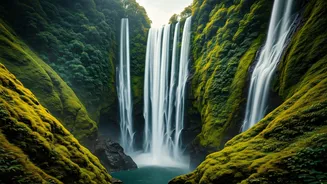
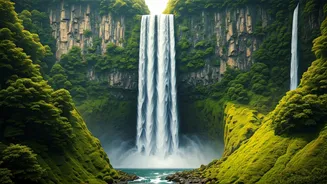
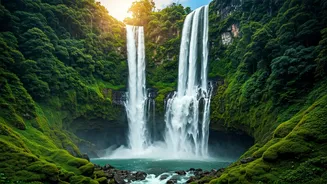
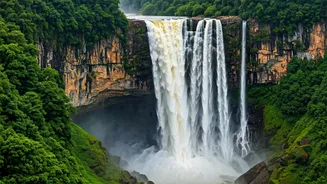
Among the hundreds of waterfalls, Nohkalikai stands supreme. As India's tallest plunge waterfall, it drops a staggering 1,115 feet from a verdant plateau into a deep, turquoise-green pool below. While stunning year-round, the monsoon transforms it from a single, elegant ribbon of water into a thunderous, powerful column that seems to tear a hole in the sky. Its power is matched only by the haunting local legend behind its name. In the Khasi language, “Nohkalikai” means “the leap of Ka Likai,” telling the story of a grieving mother who, in a fit of despair, leaped from the cliff. The falls are thus seen not just as a geographical wonder but as a permanent, flowing monument to her sorrow. To stand at the viewpoint, with mist on your face and the roar of the falls in your ears, is to feel the full weight of both nature’s power and human folklore.
The Seven Sisters: A Monsoon Symphony
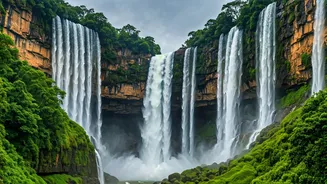
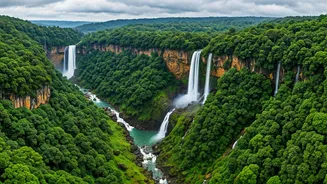
While Nohkalikai is a solo act, the Nohsngithiang Falls are a full orchestra. Better known as the Seven Sisters Falls, this natural marvel is not one waterfall but a series of seven distinct streams that cascade side-by-side over the edge of a wide limestone cliff. For much of the dry season, they are a whisper, sometimes disappearing completely. But when the monsoon arrives, they awaken in unison. Fed by the saturated tableland above, the seven streams swell into powerful, distinct torrents, creating a panoramic curtain of water nearly a thousand feet wide. They are the ultimate expression of “peak volume,” a temporary spectacle that exists only because of the immense rainfall. The sight of the sun breaking through the clouds to illuminate the seven distinct falls against the dark cliffs is one of India's most iconic natural images.
More Than Water: The Living Root Bridges
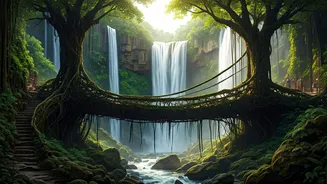
The same water that gives the falls their power also shapes the culture of Meghalaya. For centuries, the indigenous Khasi and Jaintia peoples have developed a unique form of bio-engineering to cope with the rain-swollen rivers: the living root bridges. Instead of building bridges from wood that would quickly rot in the damp climate, they guide the aerial roots of the Ficus elastica (rubber fig) tree across rivers and chasms. Over decades, these roots are woven and twisted together, eventually growing strong enough to form a sturdy, living bridge that can support the weight of people and withstand the monsoon floods. These structures, some over a hundred years old, are a testament to a deep, symbiotic relationship between humans and nature. They are living, breathing proof that in Meghalaya, the rain is not an obstacle to overcome but a force to be harnessed with patience and ingenuity.