




More Than Just a Murphy Bed
When we hear “flexible room,” many Americans might picture a pull-out couch or a Murphy bed tucked into a closet. But the concept taking root in India’s bustling metropolises is far more integrated and ambitious. A hyper-flexible room isn't just about
adding a secondary function; it's about designing a space whose primary function can change entirely depending on the time of day or the needs of the family. Architects and designers are using a sophisticated toolkit of sliding partitions, retractable walls, and bespoke modular furniture to create spaces that can be a formal dining area one moment, a children’s play zone the next, and a guest bedroom by night. The goal is transformation, not just accommodation, allowing a two-bedroom apartment to perform with the versatility of a much larger house.
Driven by Culture and Constraint
This innovative design trend is a direct response to two powerful, converging forces: rapid urbanization and enduring cultural traditions. Cities like Mumbai, Bangalore, and Delhi are among the most densely populated in the world, with real estate prices that make spacious living a luxury few can afford. For the growing urban middle class, maximizing every square foot isn't just a preference; it’s a necessity.
At the same time, the structure of the Indian family remains distinct. While nuclear families are common, the tradition of multigenerational living—where grandparents, parents, and children live under one roof—is still very much alive. Furthermore, hospitality is a cornerstone of the culture. It’s common for extended family to visit for long stays, and homes must be ready to welcome them. The hyper-flexible room is the architectural solution to this uniquely modern Indian puzzle: how do you maintain tradition and community within the physical constraints of a contemporary city apartment?
The Architectural Toolkit in Action
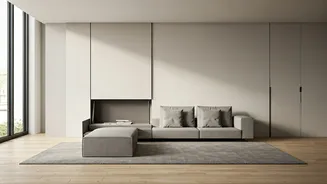
So, how is this achieved in practice? The magic lies in clever engineering and a rejection of static, single-purpose design. One common approach involves a large, open-plan living area flanked by hidden sliding or folding walls. During the day, the space is open and airy. At night, these partitions glide out to create one or two private, acoustically separated bedrooms. Another popular solution is furniture that does more than just fold away—it becomes part of the architecture. A dining table might retract vertically into a wall feature, or a desk and shelving unit for a home office could pivot to reveal a bed. Even smaller spaces, like a pooja (prayer) area, are being integrated with custom cabinetry that allows them to be beautifully displayed when in use and discreetly concealed when not, maintaining a clean, uncluttered aesthetic.
A Lesson for Western Homes
While born from a specific Indian context, this design philosophy holds powerful lessons for American homes. As remote work becomes a permanent fixture, the need for dedicated home offices that don't permanently sacrifice a guest room is a common challenge. The rise of Accessory Dwelling Units (ADUs) for aging parents and the growing popularity of minimalist and small-space living in expensive U.S. cities mirror the same pressures of space and family that Indian designers are tackling. The Indian model shows us that the solution isn't always to build bigger, but to design smarter. It encourages a shift in mindset—from thinking about our homes as a fixed collection of rooms to seeing them as dynamic, responsive environments that can adapt to the fluid nature of our lives.