






What Exactly Is a Panchang?
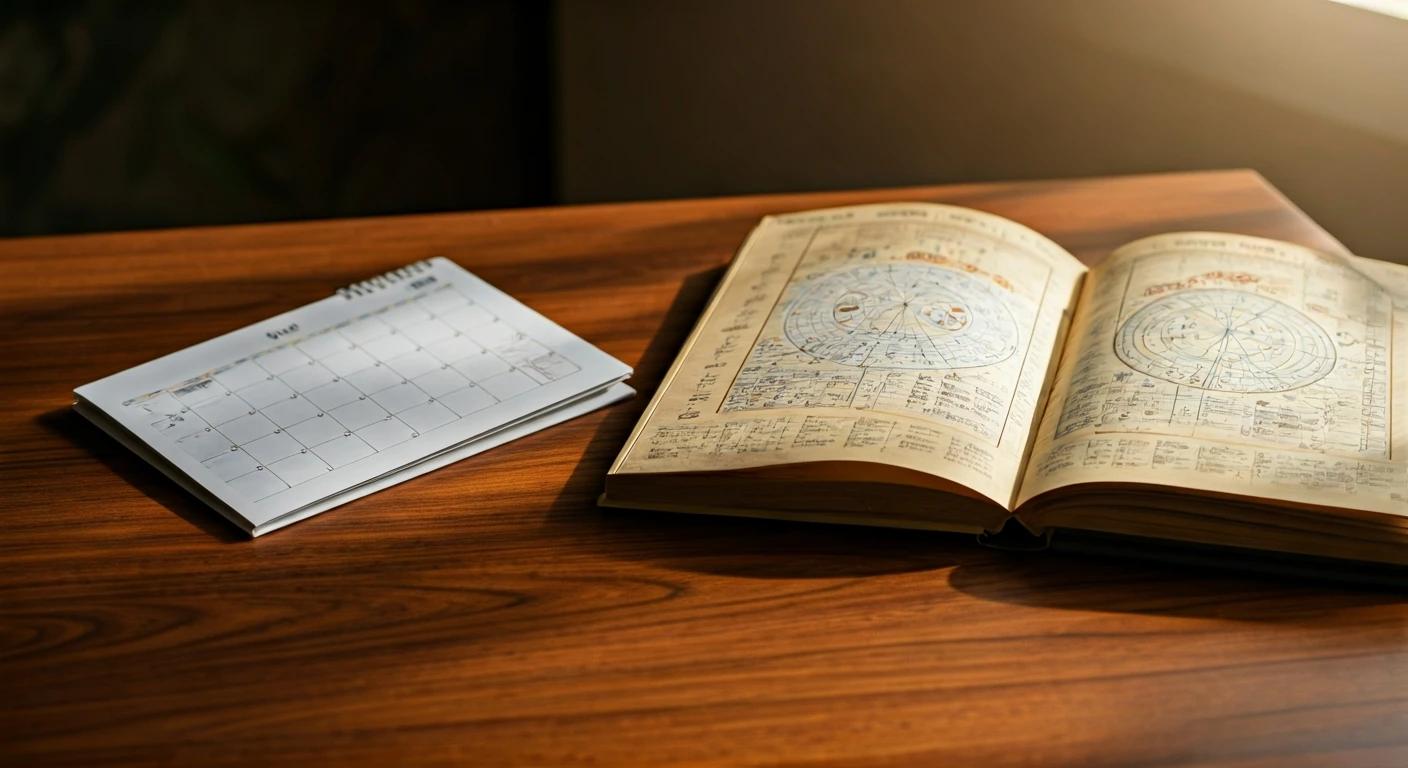
Think of the Panchang as a highly detailed, metaphysical day planner. Used for thousands of years in India, it's a Vedic almanac that goes far beyond simply marking days. The word itself comes from Sanskrit: 'panch' (five) and 'anga' (limbs). It analyzes
five key astronomical elements to determine the inherent quality and energy of any given moment. Unlike a standard Gregorian calendar that treats every day as a uniform 24-hour block, the Panchang views time as a flowing, dynamic force, with certain periods being more favorable for specific activities than others. It’s less about rigid prediction and more about understanding the energetic landscape so you can navigate it with greater awareness and success.
The Five Limbs of Time
To get a feel for the Panchang, it helps to know its five core components. You don't need to be an astrologer to grasp the basics: 1. Vara (The Day): This is the simplest element—the day of the week (Sunday, Monday, etc.). Each day is ruled by a planet and carries its own energy. For example, Saturday (ruled by Saturn) is often seen as a day for rest and reflection, not for launching a major new venture. 2. Tithi (The Lunar Day): This is the heart of the lunar calendar. A tithi is the time it takes for the moon to move 12 degrees away from the sun. There are 30 tithis in a lunar month, corresponding to the phases of the moon. Full moon (Purnima) and new moon (Amavasya) are powerful tithis often reserved for spiritual practices or new beginnings. 3. Nakshatra (The Lunar Mansion): The zodiac is divided into 27 nakshatras, or star constellations, where the moon resides on a given day. Each nakshatra has its own quality—some are gentle, some are sharp, some are best for healing, others for action. 4. Yoga (The Auspicious Union): This is a calculation based on the combined longitudes of the sun and moon. There are 27 yogas, and they determine the general auspiciousness of a day. 5. Karana (The Half-Tithi): Each tithi is divided into two karanas. This is a finer, more detailed layer that adds nuance to the day's energy.
Good Days vs. Bad Days
The Panchang isn't about labeling days as universally "good" or "bad." Instead, it identifies periods that are supportive (auspicious, or 'shubh') or unsupportive (inauspicious, or 'ashubh') for certain actions. An auspicious time, known as a 'muhurta,' is like having a cosmic tailwind. For instance, a day with a gentle nakshatra and a favorable yoga might be perfect for a wedding or signing a contract. Conversely, a day with a 'sharp' nakshatra might be better for tasks that require cutting things away—like ending a bad habit or decluttering your home—but not for starting a new partnership. The goal isn't to live in fear of 'bad' days, but to align your important actions with times that naturally support them.
A Practical Panchang Plan for July
So, how do you apply this to your July schedule? Start by looking at the major lunar events. A typical July will feature a powerful full moon and a quiet new moon. Use these as guideposts: * Around the New Moon (Amavasya): This is a time of low lunar energy, ideal for introspection, rest, and planning. Schedule your strategic thinking, journaling, or quiet brainstorming sessions during this phase. It's traditionally a time to honor ancestors and clear away old energy, not for launching a new product. * During the Waxing Moon (Shukla Paksha): As the moon grows, energy builds. This two-week period is excellent for starting new projects, initiating conversations, planting seeds (literally and metaphorically), and pushing forward on goals. * Around the Full Moon (Purnima): This is the peak of lunar energy. In July, this is often Guru Purnima, a day for honoring teachers and mentors. It's a powerful time for culmination, celebration, and spiritual or creative pursuits. It can also bring heightened emotions, so it's a good time to be mindful of your reactions. * During the Waning Moon (Krishna Paksha): As the moon shrinks, the energy turns inward. This is a great time for finishing projects, editing, organizing, and letting go of things that no longer serve you.