







Beyond the Dog-Eared Textbook
For generations, science education in many parts of the world has been defined by its limitations. A classroom of 40 students might share one microscope, a single worn-out model of the solar system, or a frog preserved in formaldehyde that few get to
see up close. This is especially true in a country like India, which has the world's largest student population—over 250 million. Equipping every single school with state-of-the-art physical laboratories is a logistical and financial Everest. This resource gap often leads to rote memorization rather than true conceptual understanding. Students read about the Krebs cycle or planetary orbits but never develop an intuitive feel for these complex systems. The challenge has always been one of scale: how do you provide a rich, hands-on learning experience to hundreds of millions of students at once? The answer, it seems, isn't being found in building more labs, but in building virtual ones.
So, What Is an AI Sandbox?
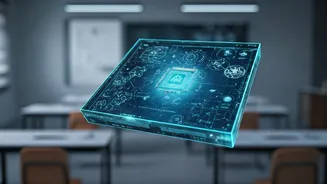
Let’s demystify the buzzwords. At its core, a “3D Interactive AI Sandbox” is a software platform, usually accessed through a virtual reality (VR) or augmented reality (AR) headset. Think of it less like a video game and more like an infinite, intelligent laboratory where the laws of physics (and biology, and chemistry) are the rules of play. The “sandbox” name is key: it’s a space where students can build, experiment, and break things without consequence. The “3D Interactive” part means students are no longer passive observers. Instead of looking at a flat diagram of a heart, they can grab a virtual one, expand it to the size of the room, and walk inside to watch the valves open and close in real-time. The “AI” component acts as a virtual tutor, guiding students through experiments, offering contextual information, and adapting the difficulty of a task based on the user's performance. It’s the difference between reading a car manual and having an expert engineer guide you through building an engine, piece by piece.
From Virtual Frogs to Martian Rovers
The applications are as vast as a science curriculum itself. In biology, students are performing virtual dissections, eliminating ethical concerns and providing every student with their own specimen. They can manipulate DNA strands or shrink down to witness cellular mitosis firsthand. In chemistry, they can mix volatile chemicals without fear of explosion, observing reactions at the molecular level. In physics, they can build virtual circuits or design a rover to navigate the surface of Mars, testing principles of gravity and mechanics. Companies like AjnaLens, an Indian firm, are at the forefront, creating platforms like AjnaVidya, which provides a library of these interactive modules mapped to the national curriculum. By partnering with state governments, they are rolling this technology out to public schools, giving students in rural villages access to educational tools that were previously the exclusive domain of elite, well-funded institutions.
A Leapfrog Moment for Education
This isn't just a story about cool gadgets in classrooms. It’s a classic example of “leapfrogging,” where a developing economy bypasses older, more expensive technologies and jumps straight to a modern, more efficient solution. Just as many parts of Africa and Asia skipped landlines and went straight to mobile phones, India is showing how a country can potentially skip the need for billions of dollars in physical lab infrastructure and go straight to scalable, high-quality virtual labs. This approach democratizes access. A student in a remote corner of Maharashtra can now have the same, or even better, learning experience as a student in a top private school in Mumbai or Delhi. For a nation focused on building a skilled workforce for the 21st century, this isn't a luxury; it's a strategic necessity.
What the U.S. Can Learn
While VR and AR technology certainly exist in the United States, their adoption in public education has been patchy and often limited to well-funded districts or pilot programs. The American ed-tech landscape is fragmented, with high costs and debates over efficacy often acting as barriers. India’s approach offers a powerful lesson: focus on curriculum-aligned content and government-backed scale. By creating a unified platform that teachers can easily integrate, and by making it affordable and accessible, the technology moves from a novelty to a core teaching tool. The U.S. could learn from this model of public-private partnership focused on mass deployment, potentially helping to close its own persistent equity gaps between wealthy and under-resourced school districts.