








1. Observe Your Landscape's Flow
Before you change anything, you need to understand where water wants to go. The single most important rule of drainage is to ensure water flows away from your home’s foundation. Take a walk around your property. Does the ground slope gently away from the house
on all sides? Look for low spots where water might naturally pool. After a light rain, or when you run sprinklers, note where puddles form and linger. These are your problem areas. If you notice significant pooling near your foundation, you may need to consider regrading, which involves adding soil to build up the area and create a positive slope. For most minor issues, however, identifying the flow path is the first step to redirecting it.
2. Clear Gutters, Downspouts, and Drains
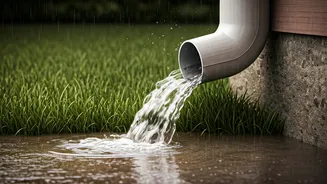
This is the most critical and often overlooked task. Gutters are your home's primary water management system. When they are clogged with leaves, twigs, and other debris, rainwater has nowhere to go but over the sides, sheeting down your walls and saturating the soil right next to your foundation. This can lead to costly water damage and foundation issues. Ensure your gutters are completely clear. Then, check your downspouts. Make sure they are not blocked and that they direct water at least three to five feet away from the house. Downspout extenders are a cheap and effective solution if yours are too short. If you have any yard drains, clear their grates of debris so they can function properly during a downpour.
3. Improve Your Soil's Sponge-like Qualities
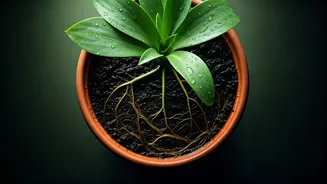
Hard, compacted soil, especially common clay soil in arid regions, acts more like concrete than a sponge. When intense monsoon rain hits, it can't soak in quickly enough, resulting in massive runoff and erosion. The solution is to improve your soil’s structure by adding organic matter. Amending your garden beds with compost, aged manure, or peat moss creates small pockets that hold water, allowing it to percolate slowly into the ground instead of washing away. This not only solves your drainage problem but also creates a healthier, nutrient-rich environment for your plants. A healthy, absorbent soil is your first and best line of defense against flash flooding in the garden.
4. Install Strategic Water-Moving Features
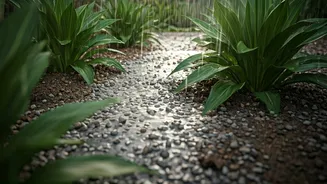
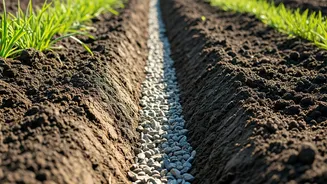
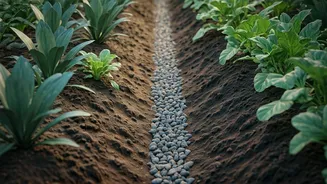
For areas with more serious flow problems, you may need to give the water a designated path to follow. A simple swale—a shallow, wide ditch with gently sloping sides—can be an attractive landscape feature that intercepts runoff and guides it to a safer area, like a street drain or a part of the yard that can handle being wet. For a more structured approach, a French drain (a perforated pipe buried in a gravel-filled trench) can move large amounts of subsurface water away from critical areas. Another beautiful and functional option is a dry creek bed, which is a trench lined with river rocks that acts as a temporary channel for water during a storm and an interesting garden feature the rest of the year.
5. Check Your Mulch and Groundcovers
Mulch is fantastic for retaining soil moisture and suppressing weeds, but the wrong kind or a poorly maintained layer can cause drainage headaches. A thick, compacted mat of fine mulch can become hydrophobic, repelling water and encouraging runoff. Before the rains start, use a garden rake to break up any compacted mulch layers to improve water penetration. Consider using a coarser mulch, like wood chips or bark, which allows water to pass through more easily. Furthermore, strategically planted groundcovers with dense root systems are excellent at holding soil in place on slopes, preventing the erosion that can clog your drainage paths and strip your garden of precious topsoil.