

The Unforgettable Entrance
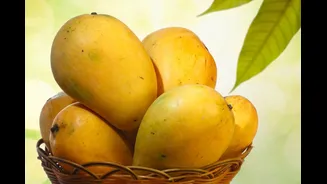
A main character has to make an impression, and the mango’s arrival is always an event. It doesn’t just sit quietly in the fruit bowl. Its fragrance—a lush, sweet perfume with hints of pine and citrus—fills the air, announcing its presence before you’ve
even taken a bite. Then there’s the color. Whether it’s the blushing red and gold of a Tommy Atkins or the vibrant yellow of an Ataulfo, a ripe mango has a visual magnetism that draws you in. It’s the sartorial equivalent of showing up to a backyard barbecue in a perfectly tailored outfit; it looks like sunshine, and it knows it.
A Complex and Storied Backstory
No compelling protagonist is a blank slate. The mango has a rich history that adds to its mystique. Originating in South Asia over 4,000 years ago, it’s a fruit with deep cultural and historical roots, considered sacred in some regions and woven into folklore and religious ceremonies. It traveled the world via trade routes, adapting and evolving into the hundreds of varieties we see today. So when you’re eating a mango, you’re not just enjoying a sweet treat; you’re tasting millennia of history, a global journey that culminated in it landing in your smoothie or salsa. That’s depth you just don’t get from a grape.
The Ultimate Glow-Up Power
A true main character doesn’t just shine on their own; they elevate every scene they’re in. This is the mango’s superpower. A boring chicken salad? Add diced mango and it becomes a tropical delight. A simple bowl of sticky rice? Top it with sweet, juicy mango slices for a world-class dessert. It can transform a bland fish taco, brighten a garden salad, and turn plain yogurt into a luxurious breakfast. Its ability to be both the star of the show (as in a mango sorbet) and a brilliant supporting player (a key ingredient in a spicy chutney) proves its incredible range. It has no bad angles.
It Demands a Little Bit of Skill
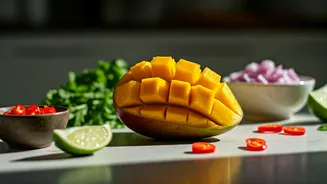
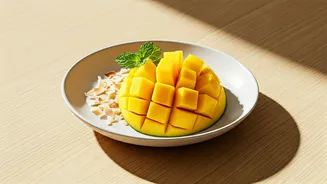
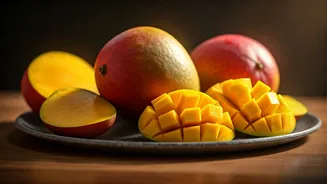
Let’s be honest: a mango isn’t as mindlessly easy to approach as a banana or an apple. There’s that large, flat pit in the middle, a puzzle that needs solving. Learning how to properly slice a mango—scoring it into cubes or using the 'glass trick' to scoop out the flesh—is a rite of passage. This slight barrier to entry only adds to its allure. It makes the reward that much sweeter. Conquering the mango pit feels like a small victory, a moment of connection with your food that’s more engaging than simply twisting off a stem. It asks for a little effort, and in return, it gives you everything.
The Flavor Arc is Unmatched
The taste of a perfect mango is a narrative in itself. It’s not just 'sweet.' A ripe mango has a complex flavor profile that moves from floral and perfumed to intensely sugary, with a tangy, almost citrusy finish that keeps it from being cloying. Depending on the variety, you might get notes of peach, pineapple, or even a hint of coconut. An unripe mango, meanwhile, has its own character arc, providing a sour, crunchy bite that’s the hero of countless Asian salads and pickles. This evolution from tart and firm to lush and sweet makes it a dynamic and endlessly interesting fruit to eat throughout its life cycle.