






Time Warps For Real
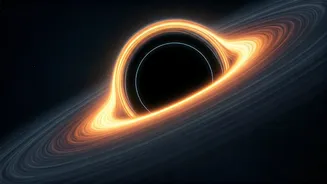
In movies, time travel is a complex plot device. Near a black hole, time distortion is a fundamental law of nature. According to Einstein's theory of general relativity, the immense gravity of a black hole warps spacetime itself. For an observer safely
watching from a distance, someone falling toward the event horizon—the point of no return—would appear to slow down, their image turning redder and dimmer until they seem to freeze in place for eternity. But for the person falling in, time would feel perfectly normal as they cross the invisible threshold. If they could somehow survive and return, they would find that thousands or even millions of years had passed for the rest of the universe. It’s not a plot twist; it’s just physics.
They Aren't Cosmic Vacuum Cleaners
Many people picture black holes as aggressive cosmic vacuums, sucking up everything in their path. The reality is more passive. A black hole is just an object with an immense amount of mass packed into an incredibly small space. Its gravitational pull is powerful, but it follows the same rules as any other massive object. If you replaced our sun with a black hole of the exact same mass, Earth wouldn't get sucked in; it would continue orbiting just as it does now (though it would get very, very cold). You have to get extremely close to a black hole—inside its event horizon—to be trapped. They don’t hunt; they just wait.
Getting Close Is a Stretching Experience
Falling into a black hole isn’t a quick, explosive end. It’s a process nicknamed “spaghettification,” and it’s as strange as it sounds. As an object approaches the singularity at the center, the gravitational pull on the part of the object closer to the black hole becomes exponentially stronger than the pull on the part farther away. This tidal force would stretch any object—a star, a planet, or a person—into a long, thin strand of atoms, like a piece of spaghetti being pulled from both ends. This process would tear you apart molecule by molecule long before you reached the center. It’s a uniquely gruesome and entirely non-fictional way the universe can unmake something.
They Can Evaporate
Perhaps the most counterintuitive thing about black holes is that they aren’t entirely black or permanent. The brilliant physicist Stephen Hawking theorized that, due to quantum effects at the edge of the event horizon, black holes must emit a faint trickle of particles. This phenomenon, now known as Hawking radiation, means that black holes very slowly lose mass. Over unimaginable timescales—trillions upon trillions of years for a sun-sized black hole—they can completely evaporate and disappear. The idea that the universe’s most perfect trap has a leak is a testament to how quantum mechanics and gravity collide in the most unexpected ways.
They Might Erase Information Forever
This is where things get truly weird, even for physicists. One of the bedrock principles of physics is that information can never be truly destroyed. You can burn a book, but in theory, you could reconstruct the information in its pages from the ash, smoke, and heat. But what happens to the information of something that falls into a black hole? Does it get trapped inside? If the black hole eventually evaporates, is that information lost forever? This question, known as the black hole information paradox, pits two pillars of modern physics—general relativity and quantum mechanics—against each other. Scientists are still fiercely debating the answer, but the possibility that black holes are the universe's ultimate shredders challenges our most basic understanding of reality.