

1. Every Piece of Furniture Has a Double Life
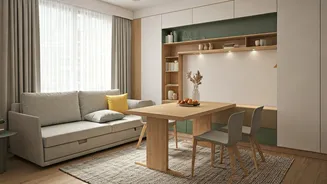
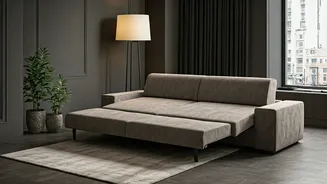
In the U.S., we might have a coffee table that lifts to become a desk. In a modern Mumbai apartment, that concept is pushed to its limits. Think beds that fold seamlessly into a wall, revealing a full-sized sofa underneath. Dining tables aren't just extendable;
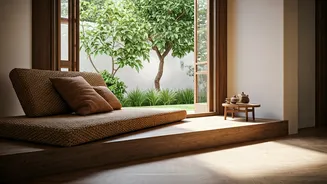
they might collapse into a slim console table or even disappear into a cabinet. The 'diwan,' a traditional low-slung couch, serves as seating during the day, a guest bed at night, and often features massive built-in storage drawers below. This isn't about gimmicks; it's a foundational principle where every major item must justify its footprint by serving at least two purposes.
2. The Living Room Is a Flexible Zone
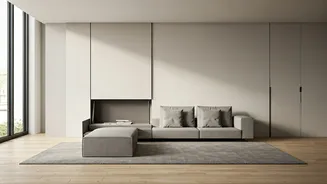
The American concept of a living room is often static: a sofa, a couple of armchairs, and a TV, all fixed in place. In many Indian homes, the living area is the heart of family life and must be incredibly adaptable. It needs to be a place for daily relaxation, a formal space for entertaining guests ('chai'), a play area for children, and sometimes even a prayer space. The furniture reflects this. Instead of a single, massive sectional, you might find a collection of lighter, modular pieces—stools, ottomans, and floor cushions—that can be easily reconfigured or cleared away to open up the floor. This creates a room that transforms based on the needs of the moment, not one that dictates a single use.
3. Vertical Space Is Prime Real Estate
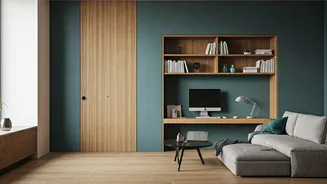
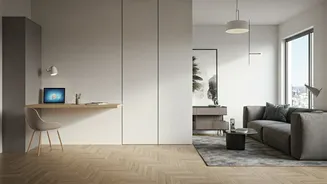
When you can't build out, you build up. This is a common mantra in small-space design, but Indian interiors execute it with particular flair. It goes beyond simple bookshelves. You'll see floor-to-ceiling custom cabinetry that integrates storage, a media unit, and even a small fold-down desk (a 'murphy desk'). In bedrooms, the space above the door is often utilized for a 'loft' storage area for seasonal items like blankets or luggage. Kitchens feature cabinets that reach the ceiling, with the highest shelves used for less-frequently accessed spices and appliances. It’s an unspoken rule: any blank wall space is a missed opportunity for smart, discreet storage.
4. Niches and Nooks Are Never Wasted
Awkward architectural features that might be ignored in a larger home are seen as opportunities. A small recess in a wall becomes the perfect spot for a compact 'mandir' (prayer nook). The space under a staircase isn’t a forgotten closet; it’s transformed into a cozy reading bench with built-in drawers or a highly organized shoe cabinet. These clever solutions, born from a philosophy of 'Jugaad'—a flexible approach to problem-solving and innovation—ensure that no inch is left without a purpose. It turns potential design flaws into charming, functional features.
5. Boundaries Are Blurred (Intentionally)
While open-concept living is popular in the U.S., Indian homes often employ a more nuanced approach with 'broken-plan' layouts. Instead of knocking down all the walls, they use visual and semi-permanent dividers to create distinct zones without sacrificing the sense of space. Think decorative screens ('jaalis'), glass partitions, or strategically placed furniture that suggests a boundary between the living and dining areas. This allows for both privacy and togetherness, letting a room serve multiple functions simultaneously without feeling chaotic. A parent can work at a small desk in one corner while children watch TV in another, all within the same larger space.