






This Isn't Your Grandfather's Space Race
Forget the black-and-white images of the 1960s. The original space race was a two-horse affair, a Cold War proxy battle between the United States and the Soviet Union for ideological supremacy. Today’s lunar rush is far more complex and crowded. It's
a multi-polar scramble involving established superpowers, rising nations, and—for the first time—billion-dollar private corporations. While national prestige is still a factor, the motivations are now intensely commercial and strategic. The goal is no longer just to get there and plant a flag; it’s to stay, build, and extract value. This shift transforms the Moon from a symbolic destination into a geopolitical and economic frontier, the solar system’s new high ground.
Meet the New Lunar Players
The field is more crowded than a rush-hour subway. The United States is leading the charge with its Artemis program, a government-led effort to return astronauts to the Moon, but with a critical twist: it’s leaning heavily on private partners. Companies like SpaceX are building the human landers, while firms like Intuitive Machines—which successfully landed its Odysseus craft in 2024—are sending robotic scouts through the Commercial Lunar Payload Services (CLPS) initiative. On the other side of the globe, China has become a formidable lunar power with its successful Chang'e missions and has announced plans for a joint lunar base with Russia. Not to be outdone, India made history by becoming the first nation to land on the Moon's South Pole in 2023, and Japan executed a stunningly precise “pinpoint” landing with its SLIM craft in 2024. Even the UAE and Israel have lunar ambitions, rounding out a truly global field.
The Prize: Water, Real Estate, and Power
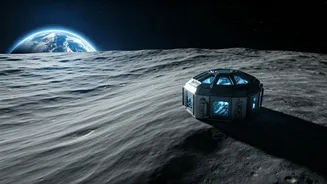
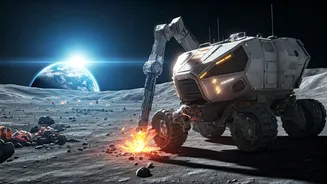
So, what’s the big prize? In a word: water. Discoveries have confirmed the presence of significant water ice deposits in permanently shadowed craters at the Moon’s poles, especially the South Pole. This isn't about quenching thirst; it’s about creating fuel. Water can be broken down into hydrogen and oxygen, the primary components of rocket propellant. A Moon with self-serve gas stations fundamentally changes the economics of space exploration, making it a potential stepping stone to Mars and beyond. Beyond fuel, companies are prospecting for valuable resources like Helium-3, a potential fuel for clean nuclear fusion. Finally, there's the simple matter of real estate. The best spots—areas with both access to water ice and near-constant sunlight for solar power—are limited. Securing a foothold in these prime locations is a strategic imperative, akin to controlling a vital shipping lane on Earth.
A Wild West With No Sheriff
This frantic rush is happening in a legal gray area. The foundational law of space is the 1967 Outer Space Treaty, which states that no nation can claim sovereignty over the Moon or other celestial bodies. It’s the reason you can’t buy an acre on the Moon, despite what novelty websites claim. However, the treaty is silent and ambiguous on the issue of resource extraction. Can a country or a company mine lunar ice and claim it as their own? The U.S. is trying to establish a framework with the Artemis Accords, a set of principles signed by dozens of countries (but notably not by rivals China and Russia) that supports the idea of commercial resource extraction. This sets the stage for a major international debate: Is the Moon a shared global commons to be preserved, or is it the next frontier for resource competition, a 'Wild West' where the rules are written by those who get there first?