



Better Traffic Flow, Fewer Bruises
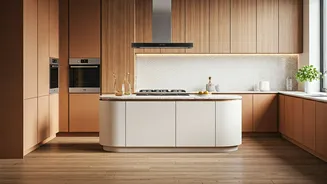
The most immediate functional benefit of a rounded island is its effect on traffic patterns. In any busy kitchen, the island can become an obstacle. Sharp, 90-degree corners are notorious pinch points, creating awkward paths and leading to more than a few
bruised hips. A curved design eliminates these corners entirely. It allows people to move more fluidly around the space, whether they're grabbing a drink from the fridge, helping with meal prep, or simply passing through. This improved flow makes the kitchen feel larger and less congested, even in more compact layouts. The functional gain is a smoother, more intuitive path through the room; the aesthetic gain is a sense of effortless movement and grace.
A Safer Choice for Families
For households with young children, sharp corners are a constant, low-level hazard. A kitchen island's corners are often at the perfect height to cause a nasty bump or cut for a toddler on the move. Opting for a rounded or curved island edge immediately mitigates this risk, creating a more kid-friendly environment. This peace of mind is a significant functional advantage for parents and grandparents. Beyond the immediate safety aspect, the softer edges contribute to a gentler, more nurturing atmosphere in the home’s central hub, reinforcing the kitchen’s role as a safe and welcoming space for everyone in the family.
The Ideal Social Gathering Spot
A rectangular island creates a linear arrangement, often feeling like a service counter where one person is on the “inside” and everyone else is on the “outside.” A rounded island breaks down this barrier. Its curved shape is inherently more communal, drawing people in and encouraging conversation. Much like a round dining table, it allows everyone seated to see and interact with each other more easily. There are no “bad seats” at the end of the counter. This makes the island a more effective social hub for casual weeknight dinners, homework sessions, or hosting guests who inevitably congregate in the kitchen. It turns the island from a simple workstation into the home's social centerpiece.
A Unique Sculptural Statement
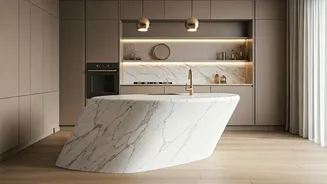
While the functional benefits are compelling, the aesthetic appeal—the “form”—is what truly sets a rounded island apart. A kitchen is typically dominated by straight lines and hard angles: the cabinetry, the appliances, the backsplash tiles. A curved island introduces an organic, sculptural element that provides immediate visual relief. It acts as a focal point, breaking up the geometric rigidity and adding a touch of sophisticated softness. Whether it’s a gentle semi-circle at one end or a full, sweeping curve, the shape feels custom and luxurious. It can make a standard kitchen look like a professionally designed space, adding a layer of artistry that a simple rectangle cannot match.
Smarter Use of Seating and Space
A curved design can also be a clever solution for maximizing seating in a tight or unconventionally shaped room. A straight, rectangular island dictates a rigid seating line. A curved overhang, however, can often tuck more stools into the same footprint without feeling crowded. The gentle arc gives each person a bit more elbow room and a better sightline to their neighbors. Furthermore, in smaller kitchens, a rounded end can be a space-saving maneuver. By shaving off the corners, it can open up a walkway or improve clearance for a nearby appliance door, proving that a more beautiful form can also be a more intelligent use of space.