




The Science of the Sparkle
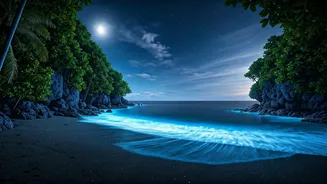
What you’re witnessing isn’t a special effect from a fantasy film; it’s a defense mechanism. The otherworldly glow comes from tiny marine organisms, most often a type of plankton called dinoflagellates. When the water they live in is disturbed—by a wave,
a kayak paddle, or your own swimming hands—they emit a flash of light. Think of it as a microscopic burglar alarm. The flash is meant to startle a potential predator, and in a beautiful twist of evolution, it also illuminates that predator, making it visible to even bigger hunters. For us, however, it’s pure spectacle. Millions of these single-celled organisms flashing in unison create the illusion that the water itself is alive with light, a liquid galaxy responding to your every move.
Creating the Perfect Conditions
Chasing this natural phenomenon requires a bit of planning. You can’t just show up to any beach and expect a light show. The key is darkness. The best viewing opportunities occur during a new moon, when the sky is at its blackest, allowing the faint glow to pop. A bright full moon can easily wash out the effect. Warm, calm waters in sheltered bays also create an ideal environment for the dinoflagellates to thrive. That’s why many of the world’s most famous glowing bays are found in tropical or subtropical climates. Plan your trip around the lunar calendar and aim for the darkest nights of the month to give yourself the best possible chance of seeing the sea sparkle.
Where to Find the Floating Stars
While the phenomenon can occur worldwide, a few locations are so reliable and brilliant they’ve become legendary. Topping nearly every list is Mosquito Bay on the island of Vieques, Puerto Rico. Officially designated the brightest bioluminescent bay in the world by Guinness World Records, its unique geography traps an incredible concentration of dinoflagellates. A kayak tour here feels like paddling through a sea of stars. In the Maldives, particularly on Vaadhoo Island, the “Sea of Stars” effect often happens right on the shoreline, as waves deposit glowing plankton onto the sand. For those traveling in Asia, the waters around Krabi, Thailand, offer stunning nighttime boat tours. And in the Caribbean, the Luminous Lagoon in Jamaica is a large, glowing estuary where tour boats leave a shimmering wake, and swimmers are enveloped in an ethereal blue aura.
An Experience Better Lived than Filmed
In an age of constant documentation, one of the most common sights at a bioluminescent bay is the faint glow of a phone screen as someone tries—and fails—to capture the magic. The light from bioluminescence is beautiful but fleeting, and it’s notoriously difficult to photograph without professional equipment and specific settings. Your iPhone camera simply can’t do it justice. This is, in a way, the secret power of the experience. It forces you to be present. Instead of seeing the moment through a screen, you’re fully immersed in it: the cool water, the silent darkness, and the impossible light dancing on your skin. The story you tell later won’t be about the perfect photo you got. It will be about the shared gasp of wonder, the feeling of swimming in starlight, and the quiet, unforgettable magic of it all.