






The Festival of Chariots
The Ratha Yatra, or the Festival of Chariots, is an ancient Hindu festival held annually in the coastal city of Puri, in the state of Odisha. It’s one of the oldest and largest religious processions on the planet, drawing crowds that can swell to over
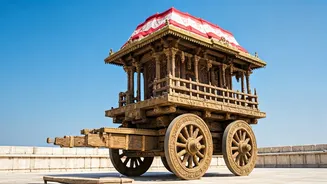
a million people. The centerpiece of the event is a journey. Three deities—Lord Jagannath, his elder brother Balabhadra, and their sister Subhadra—leave their home in the towering Jagannath Temple for a nine-day vacation to another temple, the Gundicha, considered their aunt’s house. This isn't a symbolic move; their massive, ornate wooden idols are physically brought out of the inner sanctum and placed on three colossal, custom-built chariots, which are then pulled by hand by thousands of devotees through the city streets. For believers, getting a glimpse of the deities on their chariots, or even touching the ropes used to pull them, is an act of immense spiritual merit.
Meet the Deities
Unlike the more familiar, naturalistic representations of gods in the Hindu pantheon, the idols of Jagannath, Balabhadra, and Subhadra are distinct and abstract. Carved from sacred neem wood, they feature large, circular eyes, no visible limbs, and bold, stylized forms. Lord Jagannath, whose name means “Lord of the Universe,” is a form of the Hindu god Vishnu. His iconic black face and large white eyes are instantly recognizable across India. The origin of this unique form is steeped in legend, but it represents a deity that is accessible, unconventional, and deeply beloved. The festival is a rare occasion when these deities, normally cloistered within the temple and accessible only to Hindus, are brought out into public view for everyone, regardless of caste or creed, to see.
Building the Divine Vehicles
The phrase “preparing” in the headline is key. The Ratha Yatra's grandeur begins months before the procession. The three chariots are not permanent structures; they are built from scratch every single year using ancient, prescribed methods. A specific team of carpenters, blacksmiths, and painters, whose families have held these hereditary duties for centuries, undertakes the work. They use specific types of wood from designated forests, following strict rules of measurement that are part of a sacred, unwritten tradition. The largest chariot, for Lord Jagannath, stands about 45 feet tall, has 16 wheels, and is draped in vibrant red and yellow cloth. The sheer scale of this artisanal, community-driven effort is a spectacle in itself—a testament to living tradition in the 21st century.
The Original Juggernaut
If the scale of this event sounds unstoppable, you’re not wrong. The English word “juggernaut,” meaning an overwhelming, destructive force, is derived directly from Jagannath and the Ratha Yatra. Early European observers were stunned by the immense size of the chariots and the frenzied devotion of the crowds pulling them. They recounted (often exaggerated) tales of devotees throwing themselves under the wheels in acts of religious ecstasy. While those accounts are largely considered colonial misinterpretations, the sheer power of the procession—both physical and spiritual—is undeniable. The chariots are so heavy that it takes the collective force of thousands of people, straining on thick coir ropes, to move them even an inch. It is the ultimate expression of collective will and faith.