





What You're Actually Looking For
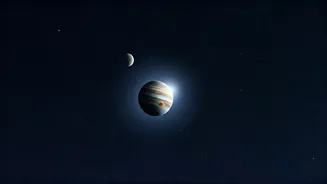
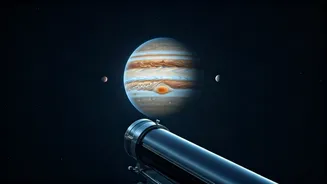
When astronomers talk about a “moon transit,” they’re describing a miniature eclipse. From our perspective on Earth, one of Jupiter’s moons passes directly in front of the planet. As it does, it casts a tiny, perfectly round, and impossibly black shadow
on Jupiter’s swirling cloud tops. Through a telescope, you can watch this little dot of shadow slowly crawl across the face of the gas giant over the course of a couple of hours. It’s a dynamic, real-time event that transforms Jupiter from a static picture into a living, moving system. It’s not just the moon you’ll see, but its shadow, creating a mesmerizing 3D effect that underscores the vastness of space.
Meet the Performers: The Galilean Moons
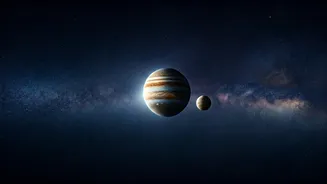
The stars of this show are the four largest of Jupiter’s 95 known moons, discovered by Galileo Galilei in 1610. Seeing them for the first time is a rite of passage for any amateur astronomer. They appear as four bright pinpricks of light dancing around the planet, changing their configuration night after night. Get to know the cast: - **Io:** The innermost of the four, Io is the most volcanically active body in our solar system. It orbits Jupiter quickly, completing a lap in less than two days, making its transits relatively frequent. - **Europa:** A
The Gear You Really Need
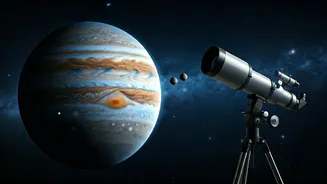
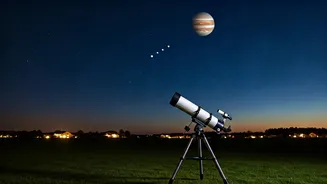
The phrase “backyard telescope” can be intimidating, but you don’t need a Hubble-class instrument. In fact, a good pair of 7x50 or 10x50 binoculars, held steady on a tripod, is enough to reveal the four Galilean moons as tiny stars flanking the planet. You’ll see them, but you won't see the transits. To see a moon’s shadow transit across Jupiter, you’ll need a small telescope. A 4-inch (or roughly 100mm) reflector or refractor telescope is a great starting point and is powerful enough to clearly resolve the moons and their shadows under good conditions. If you have a 6-inch or 8-inch Dobsonian-style reflector—one of the most popular and cost-effective types for beginners—you’re in for a real treat. These scopes gather more light, providing a brighter, sharper image that makes the tiny black shadow pop against Jupiter’s cloudy bands.
Timing Is Everything: How to Plan Your Hunt
Moon transits don't happen every night, so you can't just point your scope at Jupiter and hope for the best. Planning is essential, but luckily, it's easier than ever. The key is to find a transit ephemeris—a fancy word for a schedule of celestial events. One of the best free resources is Sky & Telescope magazine's website, which offers a tool called "Transit Times of Jupiter's Moons." Simply enter the date, and it will generate a list of all transit, occultation (when a moon goes behind Jupiter), and eclipse (when a moon enters Jupiter's shadow) events for that period. Planetarium apps for your phone or computer, like Stellarium (free) or SkySafari, are also invaluable. They can simulate the night sky from your exact location and time, showing you precisely when a shadow will begin its journey across Jupiter's face.
Tips for a Great Viewing Experience
Once you have your target and your time, a few simple tricks can make the difference between a frustrating night and a breathtaking one. First, let your telescope sit outside for at least 30 minutes before you start observing. This allows it to acclimate to the ambient temperature, preventing air currents inside the tube from distorting the view. Second, be patient at the eyepiece. It takes time for your eye to become fully dark-adapted and to pick up subtle details. Spend several minutes just looking. You’ll be surprised how much more you see after the first 60 seconds. Finally, if you can, try to also spot Jupiter’s Great Red Spot. This colossal, centuries-old storm is sometimes visible, and your transit-finding app will tell you when it’s facing Earth, giving you two incredible phenomena to hunt for in one night.