







The Land of Festivals
On the eastern coast of India, the state of Odisha is often called the “land of temples,” and for good reason. Its cultural calendar is a dense tapestry of celebrations, with some locals claiming there’s a festival for every day of the year. From the solemn
rituals of Maha Shivaratri to the vibrant colors of the Konark Dance Festival, life in Odisha is deeply intertwined with spiritual and artistic expression. Yet, among this crowded field, one event stands alone in its scale, antiquity, and emotional fervor: the Rath Yatra of Puri. Held annually around June or July, it is not just another festival; it is the grand culmination of Odia devotion, a spectacle that transforms the seaside city of Puri into a sea of humanity united by a single purpose.
The Deities at the Center
At the heart of Rath Yatra are three specific deities from Puri's revered Jagannath Temple: Lord Jagannath (a form of the Hindu god Vishnu), his elder brother Balabhadra, and his sister Subhadra. Unlike the polished, intricate idols seen in many Hindu temples, these figures are strikingly stylized, carved from sacred neem wood with large, round eyes and no discernible limbs. Their unique form is rooted in ancient tribal traditions and legends, representing a more abstract, primal vision of the divine. For most of the year, they reside within the inner sanctum of the 12th-century Jagannath Temple, accessible primarily to practicing Hindus. But Rath Yatra changes everything. It is the one time of year the deities leave the temple's confines to travel, giving a public audience—or *darshan*—to everyone, regardless of faith, caste, or creed.
An Epic Journey by Chariot
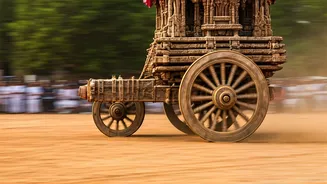
Rath Yatra literally translates to “chariot journey.” The festival’s main event is a procession where the three deities are placed on enormous, newly constructed chariots and pulled by thousands of devotees through the streets of Puri. These are not mere floats. Each chariot is a towering wooden structure, built from scratch each year by a specific caste of carpenters using traditional techniques passed down through generations. Lord Jagannath’s chariot, Nandighosha, stands about 45 feet tall and rolls on 16 massive wheels. The procession covers a roughly two-mile route from the main Jagannath Temple to the Gundicha Temple, considered the deities' 'aunt’s house,' where they rest for nine days. The sight is staggering: thick ropes, hundreds of feet long, are gripped by a crush of people, all straining together to pull the gods forward. The air fills with the sound of gongs, cymbals, and chants of “Jai Jagannath!” (Victory to Jagannath).
More Than Just a Parade
While the visual spectacle is breathtaking, the festival's true power lies in its spiritual significance. For devotees, pulling the ropes of the chariots is an act of immense devotion, believed to cleanse sins and bring spiritual merit. The journey symbolizes the gods coming down from their pedestal to meet the people, dissolving social barriers in a shared act of faith. This inclusiveness is a cornerstone of the festival's philosophy. In a society historically defined by rigid caste structures, Rath Yatra created a space where everyone was equal in the eyes of the divine. It is this blend of overwhelming scale, intricate artistry, and profound theological meaning that makes Rath Yatra the undisputed peak of Odisha’s festival calendar and one of the most powerful displays of living faith on the planet.