



More Than Just a Gallery Wall
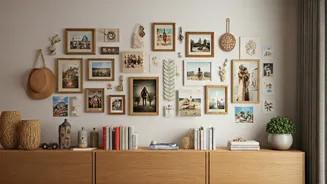
Walk into a certain type of urban Indian home today, and you’re likely to find what designers call a “travel wall.” This isn’t the familiar, neatly arranged gallery wall of matching frames popular in the West. Instead, it’s a living, breathing mosaic
of personal history. A hand-painted ceramic plate from Portugal might hang next to a wooden tribal mask from Kenya, which in turn might sit above a small, framed tapestry from a market in Rajasthan. These walls are dense, eclectic, and deeply narrative. Each object is a tangible memory, a pin on a mental map of the owner’s journeys. This isn't about coordinating colors or adhering to a specific design school; it’s about autobiography. The collection tells you not just where the residents have been, but who they are.
The Backlash Against the Beige Box
The phrase “giving personality again” hints at what came before. For much of the 1990s and 2000s, as India’s economy opened up, a new, aspirational middle and upper-middle class emerged. Their aesthetic ideal, heavily influenced by Western design magazines and a desire to appear modern, often translated into impersonal, minimalist interiors. Homes became showrooms: clean lines, neutral palettes, and furniture sets that looked like they’d been lifted straight from a catalog. While it signaled a break from the heavy, ornate furniture of previous generations, it often resulted in spaces that felt anonymous and disconnected from the vibrant culture outside their doors. The travel wall is a direct, joyful rebellion against this era of the beige box, a reclamation of color, texture, and individuality.
A Generation on the Move
So, why now? The rise of the travel wall is directly linked to the economic and social shifts of the last two decades. A generation of young Indian professionals, with more disposable income and access to budget-friendly international travel than ever before, is exploring the world. They are bringing back more than just photos. They’re returning with textiles from Southeast Asia, pottery from the Mediterranean, and art from local markets across the globe. Simultaneously, platforms like Pinterest and Instagram have democratized design inspiration, showing them that a home doesn’t have to look like a sterile hotel lobby. Instead, it can be a deeply personal, layered, and even slightly chaotic space that celebrates a global perspective. The trend is a visual testament to a generation that is both proudly Indian and comfortably global.
A New, Curated Indian Aesthetic
What makes this trend particularly interesting is that it’s not a simple return to traditional Indian decor. You won’t necessarily find a home filled exclusively with brass artifacts and heavy wooden carvings. The travel wall represents a new, hybrid aesthetic. It’s a form of personal curation where a piece of Madhubani folk art from Bihar can coexist beautifully with a modern print from a New York gallery. This confidence to mix and match—local with global, old with new, high with low—signals a mature design identity. It’s an aesthetic that says, “My heritage is part of my story, but it’s not the whole story.” The home becomes a space not just of belonging, but of becoming—a physical record of the owner’s evolving identity in a hyper-connected world.