






A Divine Journey Begins
Every summer, the coastal city of Puri in India's Odisha state transforms into the epicenter of a spiritual phenomenon that draws more than a million people to its streets. The event is Rath Yatra, or the 'Chariot Festival,' an ancient Hindu tradition
centered on Lord Jagannath, a revered form of the deity Vishnu. Unlike most Hindu idols, which are permanently enshrined within temples, Lord Jagannath and his siblings—brother Balabhadra and sister Subhadra—emerge once a year to travel to their aunt's temple, the Gundicha Temple, about two miles away. This public procession is the heart of Rath Yatra. It’s a rare occasion where devotees, regardless of caste or creed, can see the deities up close, an act considered deeply auspicious.
The Chariots of the Gods
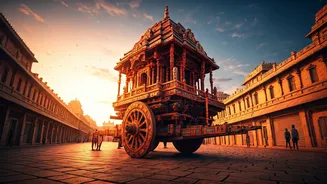
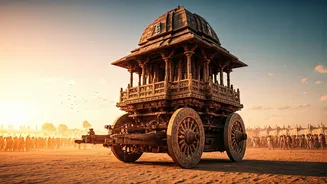
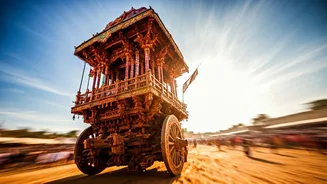
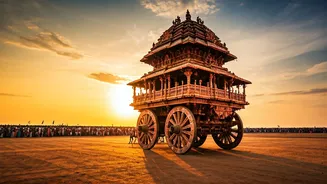
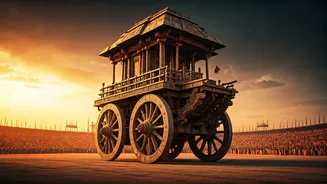
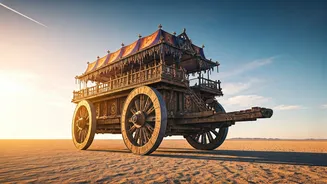
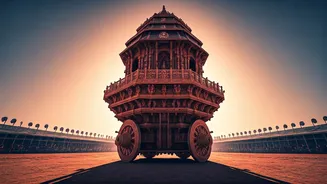
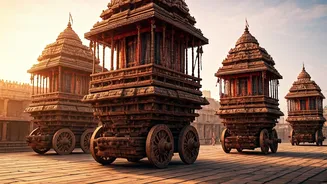
The festival's most iconic feature is its trio of colossal chariots. These aren't just vehicles; they are temporary, mobile temples, built from scratch every year by a dedicated team of carpenters using traditional techniques passed down through generations. Each chariot is a work of art, constructed from specific types of wood and adorned with vibrant fabrics, religious motifs, and painted panels. Lord Jagannath’s chariot, Nandighosha, is the largest, standing about 45 feet tall with 16 massive wheels. His brother Balabhadra’s chariot, Taladhwaja, has 14 wheels, and his sister Subhadra’s, Darpadalana, has 12. The sight of these enormous, brightly decorated structures lumbering down the city’s main thoroughfare, the Grand Road, is the defining image of the festival.
A Spectacle of Human Power
What makes the procession truly breathtaking is how the chariots move. There are no engines or animals of burden. Instead, each chariot is pulled by thousands of devotees using thick, long ropes. The collective effort is a powerful display of faith and unity. The air thrums with the sound of gongs, cymbals, and conch shells, punctuated by the rhythmic chants of 'Jai Jagannath!' ('Victory to Jagannath'). To put the scale in perspective, the crowd that gathers for Rath Yatra easily rivals the number of people who attend the Super Bowl or gather in Times Square for New Year's Eve, but concentrated in a single, moving devotional wave. Pulling the ropes is seen as an act of service to the divine, a chance to participate directly in the god's journey.
More Than Just a Festival
While rooted in deep religious belief, Rath Yatra’s significance extends into the cultural and social fabric of Odisha and beyond. Historically, the festival has been a great equalizer. On this day, the lord of the universe comes out to meet his people, and the traditional barriers of the temple are removed. Everyone, from priests to pilgrims, has a role to play. In a society where caste once dictated temple access, Rath Yatra’s open-to-all procession carries a powerful message of inclusion. For the people of Odisha, it's a cornerstone of their cultural identity, a time of immense pride, celebration, and spiritual renewal that has been observed for centuries and is now watched by millions more around the world via live broadcasts.