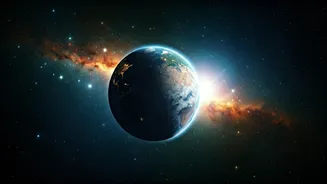







What Exactly Is 'Earth 2.0'?
Before we start the hunt, we need a target profile. What makes a planet an 'Earth 2.0'? It’s not just about finding any old rock in space. Astronomers have a checklist. First, it needs to be a terrestrial, or rocky, planet, roughly the same size and mass
as Earth. Too small, and it can't hold onto an atmosphere; too big, and it becomes a gas giant like Jupiter. But the most crucial ingredient is location, location, location. The planet must orbit its star within the 'habitable zone,' often called the 'Goldilocks Zone.' This is the sweet spot where conditions are not too hot and not too cold, but just right for liquid water to potentially exist on the surface. Since water is the one non-negotiable ingredient for life as we know it, this is the first filter every candidate planet must pass. Finding a rocky planet of the right size in the right orbit is the first step toward finding a world that could, just maybe, feel a little like home.
How Do You Find a Planet Light-Years Away?
You can’t just point a telescope and see a planet orbiting a distant star. They are incredibly small and faint, completely washed out by the glare of their parent star. So, scientists have become cosmic detectives, using clever indirect methods to find these hidden worlds.
The most successful technique is the 'transit method.' Imagine watching a distant, powerful streetlight. If a tiny moth flies in front of it, you’ll see a minuscule, brief dip in the light. Telescopes like NASA's Kepler and TESS (Transiting Exoplanet Survey Satellite) do exactly this. They stare at hundreds of thousands of stars, looking for those tell-tale, periodic dips in starlight caused by a planet passing in front of its star. The size of the dip tells them the planet's size, and how often it happens reveals its orbital period.
Another method is the 'wobble' or radial velocity method. A planet's gravity doesn't just keep it in orbit; the planet also tugs on its star, causing the star to wobble ever so slightly. By measuring this tiny stellar dance, astronomers can infer the presence and mass of an orbiting planet. These two methods combined have helped us discover thousands of exoplanets since the first was confirmed in the 1990s.
Meet the Planet Hunters
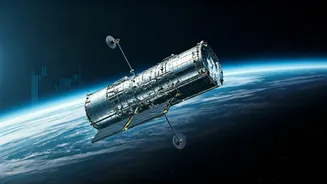
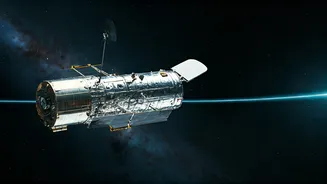
The hunt for Earth 2.0 is powered by some of the most advanced technology ever built. The Kepler Space Telescope was the trailblazer, a dedicated planet-hunting machine that stared at one patch of sky for years, discovering over 2,600 confirmed exoplanets and revolutionizing the field. Its successor, TESS, is now scanning nearly the entire sky, looking for planets around the nearest and brightest stars.
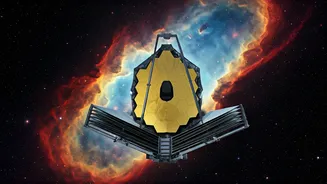
But the undisputed heavyweight champion of the current era is the James Webb Space Telescope (JWST). While Kepler and TESS are great at *finding* planets, Webb is the master of *characterizing* them. Its powerful infrared instruments can do something truly remarkable: analyze the starlight that passes through a planet's atmosphere. By looking at which wavelengths of light are absorbed, scientists can identify the chemical composition of that atmosphere. They’re hunting for biosignatures—gases like oxygen, methane, and water vapor that, in the right combination, could be a strong hint that something is alive down there.
So, Have We Found It Yet?
The short answer is: not yet. But we have found some tantalizing cousins. There's Kepler-452b, nicknamed 'Earth's older cousin,' a planet 1.5 times the size of Earth orbiting a Sun-like star. Then there’s the famous TRAPPIST-1 system, about 40 light-years away, which has a whopping seven rocky, Earth-sized planets, several of which are in the habitable zone. These systems are prime targets for the James Webb Space Telescope.
However, it's crucial to manage expectations. 'Earth-like' is a broad term. A planet could be the right size and in the right place but have a toxic, crushing atmosphere like Venus, or no atmosphere at all. The data from Webb will be our first real glimpse into the true nature of these worlds. It will help us sort the barren rocks from the potentially habitable candidates. We haven't found a confirmed twin, but for the first time in human history, we have the tools to actually look.