


Improving the Social Flow
Walk into a party in a home with a traditional rectangular island. You’ll often see guests congregating in separate clusters, blocked by sharp corners that create subtle but distinct social barriers. A rounded or curved island completely changes this
dynamic. By eliminating those corners, it creates a more natural, circular flow of traffic, allowing guests to move freely and mingle without interruption. The design inherently encourages people to gather ‘in the round,’ fostering a more inclusive and conversational atmosphere. The host, often working on one side, is no longer separated from the group but becomes part of a cohesive circle. This layout makes it easier for guests to approach the food and drinks from multiple angles, preventing the dreaded bottleneck that can kill a party’s momentum. In essence, the curve transforms the island from a simple countertop into a social hub designed for human interaction.
A Softer, Sculptural Aesthetic
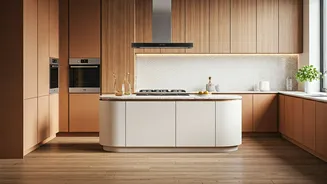
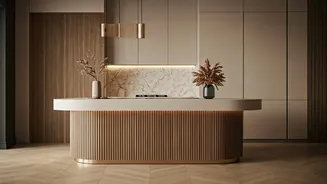
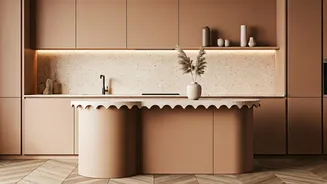
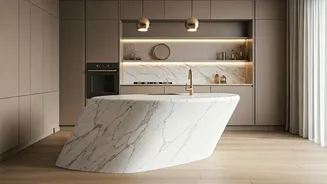
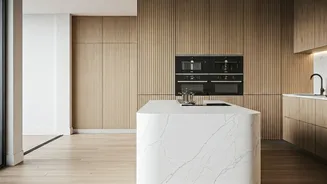
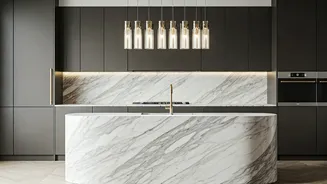
Beyond its social benefits, the rounded island is a powerful aesthetic statement. For decades, kitchens have been dominated by hard lines and sharp angles—from cabinetry to appliances. A curved island introduces an element of organic softness that provides a welcome visual contrast. It feels less like a functional utility and more like a deliberate piece of high-end, bespoke furniture. Designers are using materials like fluted wood, curved marble, and seamless quartzite to turn these islands into sculptural focal points. The arc of the island can draw the eye through the space, creating a sense of movement and grace that boxy designs lack. This architectural softness helps to elevate the kitchen from a purely utilitarian room to a living space that feels as thoughtfully designed and comfortable as a high-end living room.
Smarter Function and Zoning
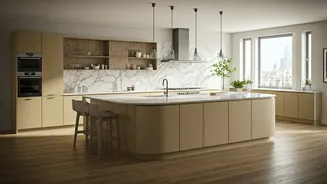
The geometry of a curved island also offers surprisingly practical advantages. The shape allows for clever zoning. For example, the outer curve can be dedicated entirely to guest seating, creating a mini-bar feel where people can comfortably sit with ample legroom, facing both the host and other guests. The inner curve, meanwhile, provides the host with an efficient, ergonomic workspace—a “cockpit” where everything from the sink to the cooktop is just a pivot away. This separation of zones means the host can prepare food and drinks without guests getting in their way, all while remaining part of the conversation. Furthermore, for families with young children, the absence of sharp, hip-height corners is a significant, if often overlooked, safety benefit. The design is intuitive, beautiful, and inherently safer.
The Ultimate Statement of Luxury
Ultimately, the adoption of the rounded island in high-end homes is about customization and intentionality. A standard rectangular island can be bought off the shelf; a sweeping, curved island of marble or walnut cannot. It requires custom fabrication, thoughtful planning, and a significant investment, signaling a level of luxury that goes beyond simply expensive materials. It shows that the homeowner and designer have considered not just how the kitchen looks, but how it *feels* and *functions* during its most important moments. It’s a design choice that says the home is built for gathering, for connection, and for effortless hospitality. In the world of luxury real estate, where unique features create value, the custom curved island has become a new, powerful symbol of a home designed for living and entertaining at the highest level.