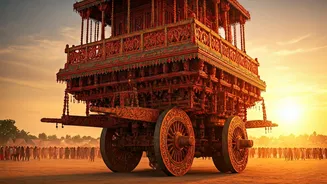










A Spectacle of Divine Proportions
Every year, typically in June or July, the coastal city of Puri in the eastern Indian state of Odisha hosts one of the world's most breathtaking religious processions: the Rath Yatra, or Chariot Festival. This isn't just a parade; it's a thundering, vibrant,
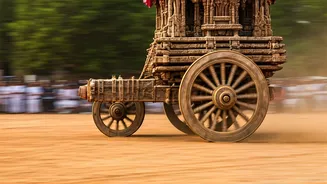
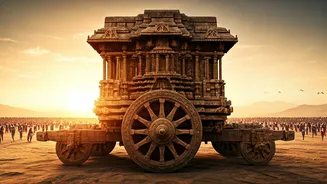
and deeply moving act of public faith. The streets become a river of people, all focused on three magnificent chariots, each towering over 40 feet high. These structures are not mere floats; they are mobile temples, hand-built annually from wood, adorned with dazzling fabrics, and carrying deities from their sacred home. The air thrums with the sound of gongs, conch shells, and chants, creating a sensory experience so powerful it's said to be life-altering.
The Annual Journey of the Gods
At the heart of the festival is a beautiful narrative. The deities enshrined in Puri's famous Jagannath Temple—Lord Jagannath (a form of Vishnu/Krishna), his elder brother Balabhadra, and their sister Subhadra—leave the inner sanctum of their temple for their annual 'vacation.' Their destination is the Gundicha Temple, considered their aunt's home, located about two miles away. For nine days, the gods reside there before making the return journey. This procession symbolizes a core tenet of Hindu philosophy: the divine reaching out to the devotee. For this one day, the gods are not hidden away in a temple accessible only to a few; they are out in the open, available for all to see, regardless of caste or creed.
More Than Just a Parade
For believers, the spiritual payoff is immense. The opportunity to see the deities, an act known as *darshan*, is considered incredibly auspicious. But the Rath Yatra offers something even more profound: the chance to participate directly in the divine journey. Devotees believe that simply touching the ropes used to pull the chariots, or even catching a glimpse of the deities atop their thrones, can cleanse sins and pave the way to spiritual liberation. This belief transforms the crowd from spectators into active participants. The energy is one of collective purpose, as thousands strain together to move the immense structures, blurring the line between the individual and the community in a shared act of devotion.
The Chariots: Moving Marvels of Craftsmanship
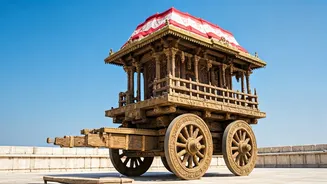
The chariots themselves are masterpieces of traditional art and engineering. Lord Jagannath's chariot, Nandighosha, stands about 44 feet tall with 16 massive wheels. Balabhadra's chariot, Taladhwaja, and Subhadra's, Darpadalana, are similarly impressive. What makes them even more remarkable is that they are constructed anew each year by a dedicated community of carpenters and artisans who have inherited the craft through generations. Using prescribed types of wood and following ancient specifications, they build these towering vehicles without modern blueprints, relying entirely on hereditary knowledge. Once the festival is over, the wood is repurposed, often as fuel in the temple's massive kitchen, symbolizing a cycle of creation and return.
An Unforgettable Human Experience
Even for a secular traveler, the Rath Yatra is an unparalleled cultural and human experience. It’s a lesson in the power of collective belief. Witnessing the sheer scale—the heaving crowds, the monumental effort to pull the chariots, the kaleidoscope of colors, and the raw emotion on the faces of devotees—is humbling. It is a moment where ancient tradition feels intensely alive and present. You are not just observing a festival; you are immersed in an 'ocean of humanity,' as it's often described, swept up in a tide of faith that has flowed through this city for centuries. It's loud, it's chaotic, and it's physically demanding, but it's also a profound connection to a timeless spiritual pulse.