




How to Spot a Planet from Light-Years Away
So, how exactly are we finding these distant planets? It’s not like we can just point a telescope and see them. An exoplanet is an impossibly small, non-luminous speck next to its blindingly bright parent star. Instead, astronomers have become cosmic
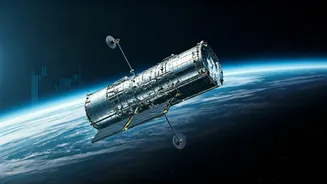
detectives, looking for the tell-tale clues these worlds leave behind. The most successful technique is called the “transit method,” which is responsible for the vast majority of discoveries. Imagine watching a distant, powerful streetlight. If a tiny gnat flies in front of it, the light will dim by a minuscule, almost imperceptible amount. That’s what NASA’s Kepler and TESS space telescopes do. They stare relentlessly at hundreds of thousands of stars, waiting for a periodic dip in brightness. If a star’s light dims by a tiny fraction, on a regular schedule—say, every 30 days—it’s a strong sign that a planet is orbiting it, repeatedly crossing in front of it from our point of view. This method not only confirms a planet's existence but also tells us its size and how long its “year” is.
A Cosmic Zoo of Bizarre Worlds
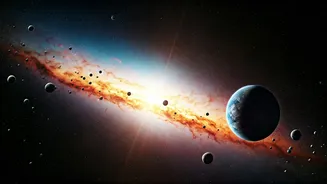
The dream, of course, is to find another Earth. But what we’ve actually found is far stranger and more varied than we ever imagined. The galaxy, it turns out, is a zoo of planetary oddities. There are “Hot Jupiters,” massive gas giants that orbit so close to their stars that their years are just a few days long and their atmospheres are scorched to thousands of degrees. We’ve found “Super-Earths,” rocky planets that are significantly larger and more massive than our own, which might have crushing gravity and thick, soupy atmospheres. Some planets orbit two stars at once, like Luke Skywalker’s home planet of Tatooine. Others are “rogue planets,” ejected from their systems to wander alone in the cold, dark void of interstellar space. This incredible diversity has rewritten our understanding of how planetary systems form. Our own solar system, with its neat separation of small rocky planets in the inner system and large gas giants in the outer system, might actually be the exception, not the rule.
The Search for a Second Earth
With over 5,500 confirmed exoplanets and thousands more candidates awaiting confirmation, the big question remains: are any of them habitable? To narrow the search, scientists focus on the “habitable zone,” sometimes called the “Goldilocks zone.” This is the orbital region around a star where temperatures are just right—not too hot, not too cold—for liquid water to potentially exist on a planet's surface. Given that all life as we know it depends on water, it’s our best starting point. But a spot in the habitable zone is not a guarantee of a paradise. A planet could be the right distance from its star but have a toxic atmosphere, no atmosphere at all, or be tidally locked, with one side perpetually baked and the other frozen. It could orbit a volatile red dwarf star that bombards it with deadly radiation flares. Finding a true Earth 2.0 requires more than just the right address; it needs the right size, the right composition, and the right atmospheric conditions.
The Next Frontier: Reading Alien Air
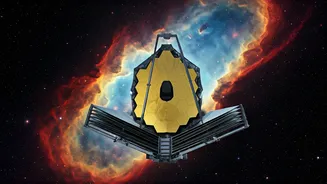
Finding these worlds was just the first step. The next, and arguably more exciting, chapter has already begun: figuring out what they’re made of. This is the primary mission of NASA’s James Webb Space Telescope (JWST). While JWST isn’t designed to find new planets, it is a master at characterizing them. When a planet transits its star, a tiny sliver of starlight filters through the planet’s atmosphere before it reaches the telescope. By analyzing that light, scientists can detect the chemical fingerprints of different gases—water vapor, methane, carbon dioxide. This technique, called transmission spectroscopy, is like reading the barcode of an alien world’s air. The ultimate goal is to find “biosignatures”—combinations of gases that are unlikely to exist without the presence of a biological process. Finding oxygen and methane together in a distant atmosphere, for example, would be a monumental discovery and a powerful hint that we are not alone.