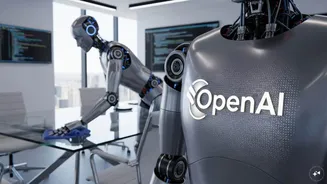









The New Lean Machine
For decades, the startup mantra was simple: get funding, hire talent, and scale aggressively. Growth was often measured in headcount. Today, that logic is being inverted. Thanks to generative AI, a skeleton crew can now achieve what once required a small
army. A single engineer can use AI assistants like GitHub Copilot to write, debug, and deploy code at an unprecedented speed. A solo marketer can generate ad copy, social media campaigns, and visual assets with tools like Jasper and Midjourney. This isn't just about efficiency; it’s a paradigm shift. Startups can now stay leaner for longer, preserving equity and extending their runway. The new goal isn’t to build a big team, but to build a powerful one, augmented by AI that handles the repetitive, time-consuming tasks that used to bog down early-stage growth.
From 'Move Fast' to 'Automate First'
The classic startup ethos, famously articulated by Facebook as "move fast and break things," is evolving. The new imperative is to "automate first." Founders are no longer just asking, "How can we build this product?" They're asking, "How can we build a system, powered by AI, that builds, maintains, and improves this product?" This means integrating AI from day one, not as an afterthought. Customer support can be largely handled by sophisticated chatbots that learn from every interaction. Financial projections and market analysis can be run continuously by AI models. Product development cycles are shortened as AI helps generate and test hypotheses. This creates a powerful compounding effect. While the old model relied on human iteration, the new model builds an engine of automated iteration, allowing startups to learn and adapt at a machine’s pace, not a human’s.
The VC Perspective: Betting on AI Leverage
Venture capitalists are taking notice, and their investment theses are changing accordingly. It’s no longer enough to just have a good idea. Investors now want to see how founders are leveraging AI to create a defensible, capital-efficient business. They are increasingly drawn to startups that can demonstrate outsized productivity and a lower burn rate. The buzzy, if slightly futuristic, concept of the "one-person billion-dollar company" has captured the imagination of Silicon Valley. While still a theoretical unicorn, it represents the ultimate expression of AI leverage: a single founder orchestrating a suite of AI agents to run a global enterprise. More practically, VCs are funding not only companies building foundational AI models but also those that are applying AI in clever, industry-specific ways to dominate a niche with a fraction of the traditional workforce.
Reshaping Roles and Risks
This AI-driven transformation isn't without consequences for the startup workforce. The demand for certain roles is shifting dramatically. Routine coding, junior marketing tasks, and basic data entry are increasingly being automated. In their place, new roles are emerging that require a different skillset: AI prompter, systems thinker, and technology orchestrator. The most valuable employees are no longer those who can simply execute tasks, but those who can effectively manage and guide AI tools to achieve strategic goals. However, this push also introduces new risks. An over-reliance on AI can lead to unoriginal, derivative products. Security is another major concern, as AI models can be manipulated or introduce vulnerabilities. Founders must now navigate the delicate balance between embracing AI’s power and mitigating its inherent weaknesses, ensuring that human oversight and creativity remain at the core of their vision.