




Beyond the Photo Dump
We’ve all done it. You return from a trip with hundreds, if not thousands, of digital photos. You scroll through them once, post a few favorites, and then they retreat into the digital ether of a hard drive or the cloud, rarely to be seen again. The images
capture what a place looked like, but they often miss what it *felt* like: the scent of rain on hot pavement, the taste of a local pastry, the texture of a weathered stone wall. This is where slow travel and art journalling intersect. Slow travel is a mindset that prioritizes connection over checklists. It’s about savoring a single neighborhood instead of rushing through five cities. It’s about quality of experience, not quantity of sights. And to truly preserve the quality of that experience, you need a memory-keeping tool that’s as intentional as the trip itself.
The Art Journal as an Experience Filter
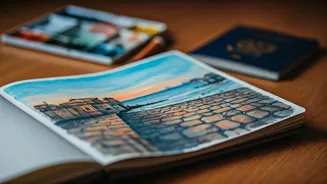
An art journal isn't a sketchbook for professional artists. Think of it as a messy, personal, multimedia scrapbook. It’s a place for your thoughts, doodles, ticket stubs, café napkins, pressed flowers, and quick watercolor impressions. The goal isn’t to create a masterpiece; it’s to create a tangible record of your unique journey.
Unlike snapping a photo, which takes a fraction of a second, the act of sketching a scene or even just writing about it forces you to stop and *notice*. You have to observe the way the light hits a building, the specific shade of blue in the sea, or the pattern on a tile floor. This process of focused observation burns the details into your memory in a way a quick picture never can. It transforms you from a passive consumer of scenery into an active participant in your surroundings.
How to Build Your Travel Kit
The beauty of art journalling is its simplicity. You don’t need a suitcase full of supplies. A minimalist kit is not only practical but also less intimidating. Start with the basics:
* A Sturdy Journal: Look for one with mixed-media paper (around 140 gsm or higher) that can handle ink, glue, and a bit of watercolor without bleeding through. A5 or A6 sizes are perfect for travel.
* A Good Pen: A waterproof fineliner pen (like a Micron or STAEDTLER) is ideal, as it won't smudge if you decide to add color over it.
* A Small Watercolor Set: A travel palette with 8-12 basic colors is more than enough. The kind that comes with a small, built-in brush is a space-saver.
* A Glue Stick or Washi Tape: For affixing ephemera like train tickets, postcards, sugar packets, or maps.
That’s it. You can always add more—colored pencils, a white gel pen for highlights—but this core kit is all you need to start capturing your world.
Beating the Blank Page
Staring at a blank page can be daunting, especially if you don’t consider yourself an 'artist.' The key is to lower the stakes and focus on capturing moments, not creating perfection. Here are a few simple prompts to get you started:
* Document Your Drink: Sketch your morning coffee cup or the colorful cocktail you had at sunset. Label it with the name of the café.
* Create a 'Found Objects' Page: Dedicate a page to things you’ve collected. Glue in a receipt, a leaf, a business card from a restaurant you loved, or a label from a local beer.
* Sketch a Single Detail: Don’t try to draw the entire cathedral. Instead, focus on one interesting gargoyle, a section of stained glass, or the pattern of the floor tiles.
* Record a Snippet of Sound: Write down lyrics from a song you heard, a phrase a local taught you, or a funny conversation you overheard.
* Make a 'Color Palette' of Your Day: Use watercolors to paint small swatches of the key colors you saw—the yellow of the taxis, the green of the park, the gray of the cobblestones.