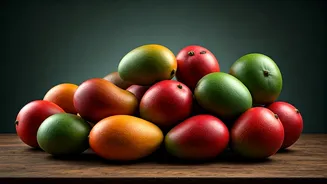




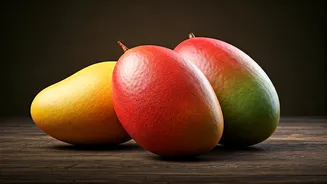
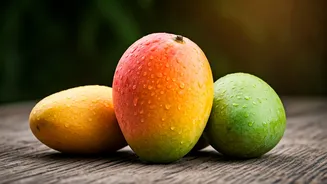
1. The Famous King: Alphonso (Hapus)
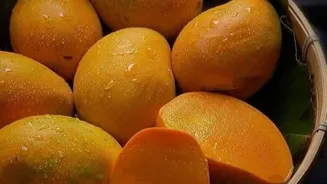
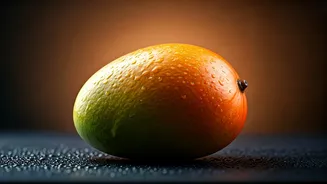
Let’s start with the one you know. The Alphonso, or 'Hapus' as it's known in Western India, is the benchmark for a reason. Grown primarily in the coastal regions of Maharashtra, its arrival in spring is a national event. What makes it special? A perfect
balance of sweetness and tartness, with a firm, buttery, non-fibrous flesh that melts in your mouth. Its skin is a sunset of gold and orange, and its aroma is intoxicating—a complex perfume of honey, citrus, and something uniquely tropical. It’s the mango that launched a thousand export businesses and the one that Indian expats will pay a small fortune for. But while the Alphonso is undeniably spectacular, it's the gateway, not the destination. It’s the lead singer of a band filled with virtuosos.
2. The Scented Queen: Kesar
If the Alphonso is the King, then the Kesar, from the foothills of Girnar in Gujarat, is the undisputed Queen. Its defining characteristic is its fragrance. Before you even taste it, you can smell it—a sweet, almost spicy scent that gives it its name, which means 'saffron'. The pulp is a vibrant saffron-orange, and its flavor is intensely sweet, but with a refined, almost floral finish. While delicious eaten fresh, the Kesar’s consistent sweetness and brilliant color make it the top choice for creating 'aamras' (mango pulp), juices, and sorbets. It’s less about the buttery texture of the Alphonso and more about a pure, concentrated burst of mango flavor and aroma. It’s the mango you remember by its scent.
3. The Northern Sweetheart: Chaunsa
As the season for Alphonsos wanes in early summer, the mango lovers of North India patiently wait for the Chaunsa. This variety, primarily from Uttar Pradesh and Bihar, is a late-season delight, arriving in July and August. The Chaunsa is a sugar bomb. It’s considered one of the sweetest mangoes in the world, with a bright yellow skin and an incredibly soft, succulent, and juicy pulp. It’s so juicy, in fact, that the traditional way to eat one is to gently knead it, break off the tip, and suck the sweet nectar directly from the fruit. Its flavor is pure, unadulterated sweetness with a pleasant citrusy undertone. Its name reportedly comes from the 16th-century ruler Sher Shah Suri, who named it after a victory in Chausa, Bihar.
4. The Quirky Favorite: Langra
The Langra is the eccentric indie darling of the mango world. Hailing from the region around Varanasi, this mango defies expectations. First, its skin often retains a greenish tint even when perfectly ripe, fooling many an amateur. Second, its flavor profile is unique. While sweet, it carries a distinct and pleasant tartness, a sharp kick that cuts through the sugar and makes it incredibly refreshing. Its name, which means 'lame' in Hindi, is tied to a local legend about a lame farmer who first cultivated the variety. The Langra has a fiercely loyal following who prize its complex flavor and its fibrous texture, which gives it more bite than its creamier cousins. To love a Langra is to appreciate character over simple sweetness.
5. The Southern Workhorse: Banganpalli
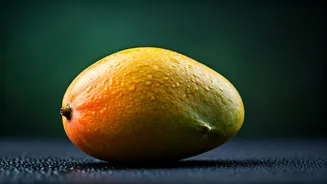
Travel south to Andhra Pradesh and you'll find the Banganpalli, also known as Benishan. This is one of the most widely cultivated and consumed mangoes in India, and for good reason. It’s large, obliquely oval, and has a beautiful, unblemished golden-yellow skin. The flesh is fiberless, firm, and has a mild, clean sweetness that isn't overpowering. While it may not have the intense aromatic complexity of an Alphonso or the sugar rush of a Chaunsa, its pleasant flavor and reliable quality make it an excellent all-rounder. It’s the mango you'll find sliced up at family gatherings, added to savory dishes like mango rice, or simply enjoyed as a perfect afternoon snack. It’s the dependable, everyday hero of the Indian mango world.