


Brian Lara (West Indies)
Imagine a batter with the grace of a ballet dancer and the destructive power of a heavyweight boxer. That was Brian Lara. The Trinidadian genius holds the record for the highest individual scores in both Test (400 not out) and first-class (501 not out) cricket.
He could dismantle any bowling attack on his day. But the West Indies teams he captained and starred in during the 90s and 2000s were a shadow of their dominant 70s and 80s predecessors. Despite his individual heroics across five World Cups, the team never made it past a semi-final on his watch, leaving one of the sport's most thrilling artists without its top prize.
Jacques Kallis (South Africa)
If you built the perfect cricketer in a lab, you’d get Jacques Kallis. He is the only player in history to score over 10,000 runs and take over 250 wickets in both Test and One-Day International (ODI) cricket. He was a rock-solid batsman, a skillful fast-medium bowler, and a brilliant slip fielder. Kallis was the ultimate triple-threat, the sport's version of a five-tool player. Yet his career coincided with South Africa’s reputation as perennial chokers on the world stage, with heartbreaking exits in 1999, 2007, and 2011. Kallis provided balance and brilliance, but never a winner's medal.
AB de Villiers (South Africa)
Known as “Mr. 360” for his uncanny ability to hit the ball to any part of the ground, AB de Villiers was a revolutionary. He redefined what was possible in batting with his audacious creativity and athleticism. He holds the records for the fastest 50, 100, and 150 in ODI history, feats that seem almost video-game-like. De Villiers was the heart of a powerful South African side, but like Kallis before him, he was haunted by World Cup misfortune, most notably a gut-wrenching semi-final loss to New Zealand in 2015 where he was left in tears.
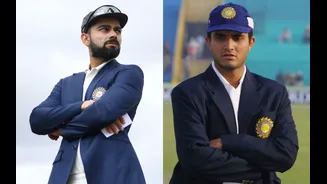
Sourav Ganguly (India)
Nicknamed the “Prince of Kolkata,” Sourav Ganguly was more than a gifted left-handed batsman; he was the captain who transformed India from a talented but timid team into an aggressive, world-beating force. He instilled a fighting spirit and self-belief that laid the groundwork for India’s future successes. Ganguly captained the team to the 2003 World Cup final, where they were comprehensively outplayed by a legendary Australian side. While his successor, MS Dhoni, would lift the trophy in 2011 with many of Ganguly's players, the man who started the revolution never got to finish the job.
Rahul Dravid (India)
Known as “The Wall” for his impeccable defensive technique and unbreakable concentration, Rahul Dravid was the ultimate team man. He was the anchor who allowed flashier players to flourish around him, compiling over 10,000 runs in both Tests and ODIs with quiet determination. He played in three World Cups, reaching the final in 2003 alongside Ganguly. He even captained India in the disastrous 2007 campaign. A player of immense class and dignity, Dravid’s career was a masterclass in substance, but the ultimate prize eluded him.
Waqar Younis (Pakistan)
With a lethal, late-swinging yorker—a full, fast delivery aimed at the batsman’s toes—Waqar Younis was one of the most feared fast bowlers of his generation. He and Wasim Akram formed arguably the most potent bowling partnership in cricket history. Tragically, a stress fracture in his back forced him to miss Pakistan's triumphant 1992 World Cup campaign. He returned to play in subsequent tournaments, captaining the side in 2003, but he could never replicate the team success he was cruelly denied a part in.
Dale Steyn (South Africa)
With veins popping and eyes blazing, Dale Steyn wasn't just a fast bowler; he was an event. For years, he was the undisputed number one bowler in the world, combining blistering pace with masterful swing and control. His strike rate—the frequency with which he took wickets—is among the best ever. Steyn was the spearhead of South Africa’s attack during their years of promise, but like his compatriots on this list, he was part of the squads that fell short in 2011 and 2015, leaving one of the most exciting bowlers ever without a world title.
Graham Gooch (England)
A powerful, mustachioed figure, Graham Gooch was the pillar of English batting for nearly two decades. A prolific run-scorer, he captained his country and was known for his relentless accumulation of runs. His World Cup story is one of pure heartbreak: he played in three finals and lost them all. He was a runner-up in 1979, 1987 (where he was captain), and 1992. No other player has come so close, so many times, without tasting victory.
Ian Botham (England)
Sir Ian Botham was England's swashbuckling, larger-than-life all-rounder. A charismatic figure who could turn a match with a blistering batting cameo or an unplayable spell of bowling, “Beefy” was pure box office. He was a force of nature who dragged England to victory on countless occasions. But at the World Cup, his Midas touch ran out. Like his teammate Gooch, he played in two finals, 1979 and 1992, and ended up on the losing side both times, a frustrating gap for a player defined by his match-winning abilities.
Kane Williamson (New Zealand)
A modern master, Kane Williamson is widely respected as much for his calm, dignified leadership as for his sublime batting. His technique is near-perfect, his temperament unshakable. Yet his World Cup story is one of almost unbearable agony. As captain, he led New Zealand to the 2019 final, losing to England on a bizarre boundary count-back rule after both the match and a tie-breaking “Super Over” ended level. He also lost the 2021 T20 World Cup final and the 2015 ODI final. Williamson embodies grace in the face of the cruelest sporting luck.