






The Ghost of an Ocean
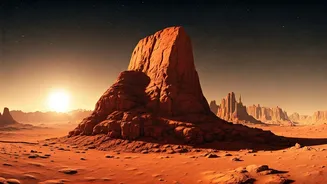
The single most compelling reason Mars captivates us is water. Today, the planet is a frigid, dusty desert with a whisper-thin atmosphere. But the evidence of a warmer, wetter past is overwhelming. Robotic explorers have sent back stunning images of ancient
river deltas, dried-up lakebeds, and canyons carved by catastrophic floods. NASA’s Perseverance rover is currently exploring Jezero Crater, the site of a former lake and river delta that could be a prime spot for preserving signs of ancient life. Scientists aren't just looking for frozen water under the surface; they are piecing together the story of how a planet with the ingredients for a temperate climate lost it all. Understanding this planetary transformation—how Mars lost its magnetic field, had its atmosphere stripped away by solar wind, and saw its oceans vanish—is crucial for understanding planetary habitability, including the long-term future of Earth.
The Ultimate Cold Case: The Hunt for Life
Where there was water, there might have been life. This is the ultimate, exhilarating question driving Mars exploration. Finding life, even microbial fossils, on another world would be one of the most profound discoveries in human history. It would tell us that life is not a fluke unique to Earth. Scientists aren't necessarily looking for little green men; they're searching for “biosignatures”—subtle chemical, mineral, or structural clues left behind by microscopic organisms. This could be specific organic molecules that are hard to create without biology, or patterns in rocks that suggest microbial mats. Missions like the Curiosity and Perseverance rovers are equipped with sophisticated labs that can analyze soil and rock samples on the spot. The long-term goal of the Mars Sample Return mission, a joint NASA and European Space Agency effort, is to bring pristine Martian rocks back to Earth where our most advanced laboratories can search them for definitive proof of past life.
A Laboratory for Planetary Science
Beyond the search for life, Mars is a perfect natural laboratory. It’s similar enough to Earth to be comparable but different enough to be illuminating. Both planets are rocky, have polar ice caps, and experience seasons. But Mars is smaller, colder, and lacks plate tectonics. By studying Martian geology, scientists can see what a planet looks like when its crust doesn’t constantly recycle itself. By studying its thin carbon-dioxide atmosphere, they can refine their models of climate change and atmospheric dynamics. Mars serves as a control group of sorts. It allows us to test our theories about how planets form, how they develop atmospheres, and what conditions make them habitable. Every piece of data, from seismic rumbles detected by the InSight lander to dust devil tracks spotted from orbit, helps us build a more complete picture of our own place in the cosmos.
Humanity's Next Giant Leap
Finally, Mars fascinates us because it’s a tangible destination. The Moon was the goal of the 20th century; Mars is the horizon for the 21st. For scientists and engineers, it represents the ultimate challenge. How do you land humans on a planet with a thin atmosphere? How do you protect them from radiation on a months-long journey? How can they live off the land by, for example, extracting oxygen from the Martian air (something the MOXIE experiment on Perseverance has already successfully done)? Solving these problems pushes the boundaries of technology in robotics, life support, and materials science—innovations that often have practical applications back on Earth. For many, the goal of a multi-planetary species, one capable of surviving a catastrophe on its home world, begins with establishing a foothold on Mars. It's not just an object of scientific curiosity; it's a potential next step for humanity.