






1. For Planetary Defense
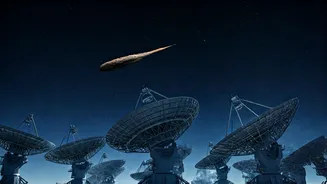
Let's get the obvious one out of the way first. We live in a cosmic shooting gallery, and agencies like NASA have a vested interest in not becoming the dinosaurs. Planetary defense is no longer science fiction; it's a serious, funded objective. The goal
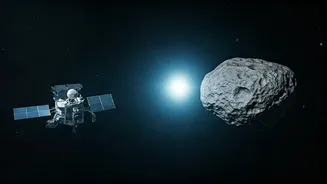
is to find, track, and characterize near-Earth objects (NEOs) that could pose a threat. This involves powerful telescopes scanning the skies for faint, fast-moving dots. But what happens if we find one with our name on it? That’s the next step. In 2022, NASA’s Double Asteroid Redirection Test (DART) mission proved humanity could alter the path of an asteroid. By deliberately crashing a spacecraft into the small asteroid Dimorphos, scientists successfully changed its orbit. It was a monumental proof-of-concept, demonstrating that we have the technology to give a threatening space rock a nudge, pushing it onto a safer trajectory years before a potential impact.
2. To Unlock the Solar System's Secrets
Asteroids are more than just space rocks; they are pristine time capsules. Formed during the birth of our solar system some 4.6 billion years ago, they are leftover building blocks that never quite made it into a planet. Because they've been floating in the cold vacuum of space ever since, they contain unaltered materials from that primordial era. By studying them, scientists can look back in time to understand how Earth and the other planets formed, and even how key ingredients for life, like water and organic compounds, might have been delivered to our world. This is the primary motivation for missions like NASA's OSIRIS-REx, which successfully returned a sample from the asteroid Bennu in 2023, and Japan's Hayabusa2, which brought back pieces of the asteroid Ryugu. Analyzing these precious grains in labs on Earth gives us a direct window into our own cosmic origins.
3. As a Pit Stop for Future Exploration
The dream of mining asteroids for precious metals like platinum gets a lot of attention, and it is a long-term possibility. But for space agencies, a more immediate resource is far more valuable: water. Water (H2O) can be broken down into hydrogen and oxygen, the two primary components of rocket fuel. If astronauts can 'live off the land' by harvesting water from asteroids, it could revolutionize space travel. Instead of launching every drop of fuel and water from Earth—a hugely expensive and limiting process—future missions could refuel at in-space 'gas stations.' This concept, known as in-situ resource utilization (ISRU), would make long-duration missions to Mars and beyond much more feasible and affordable. Chasing asteroids is therefore also about scouting future oases for humanity's expansion into the solar system.
4. To Test-Drive New Technology
Landing on, interacting with, or even just flying by a small, fast-moving, and often irregularly shaped object millions of miles away is incredibly difficult. Asteroid missions are the ultimate proving ground for next-generation space technology. They force engineers to solve immense challenges in autonomous navigation, advanced robotics, deep-space communication, and innovative propulsion systems. For example, the OSIRIS-REx mission had to autonomously navigate to a surface it had never seen before and execute a 'touch-and-go' maneuver to collect a sample, all with a significant time delay in communications from Earth. The technologies developed for these complex missions—from sophisticated guidance software to robotic arms—don't just stay in space. They often find their way back into applications on Earth and serve as the foundation for even more ambitious missions in the future.