







The Old Rule: The 'No-Hair' Theorem
To understand the new mystery, you have to know the old rule. It’s called the “no-hair theorem,” and it’s one of the coolest, most straightforward ideas in astrophysics. It states that once a black hole forms, it’s utterly simple. It can be described
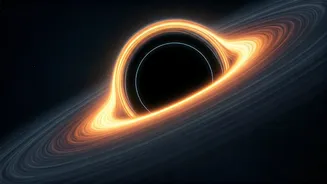
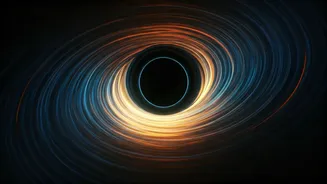
by just three things: its mass, its spin, and its electric charge. That’s it. Think of it like this: it doesn’t matter if the black hole was formed from a collapsing star, a planet made of diamonds, or a trillion rubber ducks. Once it crosses the event horizon—the black hole's edge—all the unique details, or “hair,” are shaved off. The resulting black hole is cosmically bald, a featureless void defined only by those three numbers. For a long time, this elegant simplicity was a cornerstone of black hole physics. It made them predictable, even if they were terrifying.
The Big Problem: Information Can't Die
Here's where things get messy. Another fundamental rule of the universe, this one from quantum mechanics, states that information can never be truly destroyed. Ever. You can burn a book, but the information about its pages still exists in the smoke, ash, and heat released. In theory, a sufficiently powerful supercomputer could reverse the process and reconstruct the book. Information changes form, but it doesn't vanish. This creates a massive cosmic contradiction known as the Black Hole Information Paradox. If a black hole is truly “bald,” what happens to the information of everything it swallows? If an astronaut carrying a copy of Shakespeare falls in, does the information that makes up the astronaut and the plays just get wiped from the universe? General relativity (which describes black holes) says yes. Quantum mechanics says absolutely not. And for physicists, having the two most successful theories of reality fundamentally disagree is a very big problem.
Hawking's Twist That Made It Worse
For a while, you could argue the information was just locked away inside the black hole. But then Stephen Hawking came along. He discovered that black holes aren't completely black; they leak a faint glow of particles, now known as Hawking radiation. Over an impossibly long time, this leakage causes the black hole to evaporate and disappear completely. This was a revolutionary discovery, but it deepened the paradox. Hawking's initial calculations showed this radiation was completely random, carrying no useful information about what had fallen in. So, if the black hole swallows your book, then slowly evaporates into a featureless hiss of radiation, the information is gone forever. This put physicists in a corner. Either quantum mechanics was wrong, or something was missing from our understanding of black holes.
The New Idea: A 'Hairy' Situation
This is where the mystery now deepens in a fascinating way. In his final years, Hawking and other physicists started working on a radical solution. They proposed that the “no-hair” theorem might be subtly wrong. Black holes might have a kind of “soft hair”—a faint, quantum-level fuzz of low-energy particles hovering at the edge of the event horizon. This “hair” would act as a kind of memory bank. When something falls into the black hole, its information isn’t destroyed but is imprinted onto this quantum halo. The information about our astronaut and her book of Shakespeare would be intricately encoded on the event horizon itself. Then, as the black hole evaporates via Hawking radiation, that radiation would no longer be random. It would be subtly shaped by the “soft hair,” carrying the stored information back out into the universe. The information is saved, and the laws of quantum mechanics are upheld. The mystery isn't solved, but it's transformed—the question is no longer *if* information escapes, but *how*.