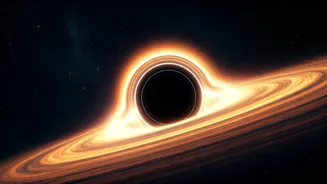







Meet the Brightest Monster
First, let's get our cosmic bearings. The object creating this mind-bending storm isn't a hurricane at all; it's a quasar, the brilliant core of a distant galaxy powered by a supermassive black hole. Discovered by astronomers at the Australian National
University, this celestial beast, officially named J0529-4351, is the most luminous object ever observed. It shines 500 trillion times brighter than our sun. The source of this impossible light is not the black hole itself—from which no light can escape—but the super-heated, chaotic swirl of matter spiraling into it. This structure, known as an accretion disk, is a cosmic traffic jam of gas, dust, and shredded stars being pulled toward the point of no return. And it's in this disk that things get truly wild.
Winds Beyond All Scale
So where does the hurricane comparison come from? The material in this accretion disk isn't just passively sliding into the abyss. It’s whipping around the black hole at incomprehensible speeds, creating what astronomers describe as a cosmic 'wind.' To put its power into perspective, they reached for the Saffir-Simpson scale we use for hurricanes. A Category 5 storm, the most destructive on Earth, features sustained winds of 157 mph or more. The 'wind' in this quasar’s accretion disk, however, is moving at nearly the speed of light. To even try and quantify it using our earthly scale is almost absurd, but that's the point. It’s a storm so far beyond our comprehension that calling it a 'Category 79' is a poetic attempt to grasp its power. It’s not a formal scientific designation but a stunning analogy: if the energy scale of storms continued that far, this is where J0529-4351 would live.
An Appetite to Match
The brightness and the furious winds are byproducts of the black hole's ravenous appetite. It is, by a huge margin, the fastest-growing black hole ever found. To sustain its brilliant quasar, it consumes an amount of matter equivalent to one sun every single day. Imagine our own star, the anchor of our solar system, being shredded and swallowed in 24 hours. That’s the daily routine for this object. The process is fantastically inefficient and violent; as matter is torn apart and accelerated, friction generates unbelievable heat and light, creating the beacon we can see from over 12 billion light-years away. This gluttony has allowed the black hole to amass a stunning weight, currently estimated at 17 billion times the mass of our sun, and it's adding another billion solar masses every few years.
Hiding in Plain Sight
If this quasar is so blindingly bright, why did it take us so long to find it? The answer is simple: it was too bright. For decades, automated sky surveys and the AI models that analyze them have been trained to filter out objects that appear as bright as nearby stars. J0529-4351 was so luminous that computer programs repeatedly misidentified it as a common star within our own Milky Way galaxy, rather than the fantastically distant and powerful quasar it truly is. It was hiding in plain sight, dismissed as something ordinary. It wasn't until astronomers at Siding Spring Observatory in Australia took a closer look with a larger telescope that its true identity was revealed. The data confirmed it wasn't a neighbor down the street, but a titan from the early universe.