





The Scent of Monsoon Rain
For anyone living in the American Southwest, the summer monsoon season is a dramatic, soul-stirring event. After months of baking under a relentless sun, the arrival of towering thunderheads brings a palpable sense of relief. It’s a multi-sensory experience:
the distant rumble of thunder, the flash of lightning across a vast horizon, and most importantly, the smell. That intoxicating perfume of rain on dry, dusty earth—known as petrichor—mixed with the resinous scent of creosote bushes, is the signature fragrance of the desert’s most anticipated season. It’s a time of renewal and sudden, vibrant life. Many of us watch this spectacle from our patios and balconies, wishing we could hold onto that feeling. As it turns out, you can, with a plant that seems to understand the monsoon’s rhythm better than any other.
Meet the 'Barometer Bush'
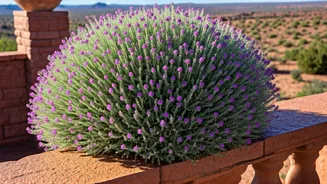
The magical bloom your monsoon balcony needs is the Texas Ranger, or Leucophyllum frutescens. While its official name sounds a bit formal, its common nicknames tell the real story: ‘barometer bush’ and ‘cenizo’ (Spanish for ash, nodding to its silvery foliage). This isn't just a plant that survives in the desert; it’s one that actively responds to its cues. The ‘magic’ is its incredible blooming habit. The Texas Ranger can sit quietly for weeks, a handsome shrub with silvery-gray or green leaves. But when the humidity rises just before a summer rain, it explodes into a riot of delicate, purple-lavender blossoms. It’s as if the plant can predict the weather, covering itself in flowers to celebrate the coming storm. This bloom is often so sudden and profuse that it looks like a purple cloud has descended upon your balcony, perfectly timed with the drama of the monsoon sky.
Perfectly Designed for Balcony Life
Beyond its stunning bloom, the Texas Ranger is a dream for container gardening, especially in the hot, dry climates where monsoons are a fact of life. Its native habitat in the Chihuahuan Desert has made it incredibly tough and self-sufficient. It thrives in full, blazing sun—the kind that fries more delicate plants. It is exceptionally drought-tolerant, meaning you can forget to water it (for a while) and it will be perfectly fine. This low-maintenance nature makes it ideal for busy people or those new to gardening. On a balcony, where pots can dry out quickly, having a plant that prefers to be on the drier side is a massive advantage. Its silvery foliage provides beautiful, year-round texture and a cooling visual contrast to the intense sun, looking good even when it’s not in bloom.
Caring For Your Weather-Wise Plant
Bringing this magic to your balcony is surprisingly simple. Here’s what you need to know: **Container and Soil:** Choose a pot with excellent drainage. Terracotta is a great choice as it allows the soil to dry out between waterings. Use a fast-draining potting mix, ideally one formulated for cacti and succulents. Amending a standard potting mix with perlite or sand can also work. **Sunlight:** Give it all you’ve got. The Texas Ranger needs at least six to eight hours of direct sunlight to thrive and produce the most spectacular blooms. A south- or west-facing balcony is perfect. **Water:** This is the most important part: do not overwater. Water deeply but infrequently, allowing the soil to dry out completely between sessions. During the hottest, driest parts of the year, this might be once every week or two. In winter, reduce watering even further. The plant’s sensitivity to humidity is what triggers blooming, not just being watered. **Pruning:** Texas Rangers have a naturally beautiful, airy shape. You can prune them lightly after a bloom cycle to encourage bushier growth, but avoid shearing them into unnatural shapes, which can inhibit flowering.
Choosing Your Perfect Variety
When you head to the nursery, you'll find there isn't just one type of Texas Ranger. Several cultivars offer different sizes and even slightly different flower colors, allowing you to choose the perfect one for your space. 'Compacta' is a great choice for smaller balconies as it stays more rounded and dense. 'Green Cloud' has greener leaves instead of the classic silver, offering a different aesthetic. 'White Cloud' produces stunning white flowers, creating a lovely alternative to the traditional purple. Ask your local nursery what they recommend for your area; they’ll know which varieties perform best in your specific climate.