

Breaking Out of the Box
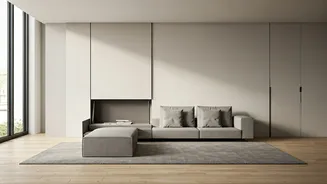
For decades, the blueprint for urban apartment living, from Mumbai to Manhattan, has been defined by the grid: a collection of rectangular rooms connected by straight, efficient corridors. It’s practical, cost-effective, and easy to build. But in a growing
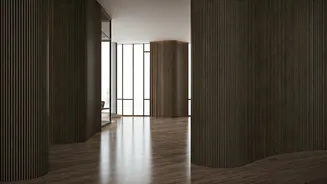
number of architect-designed apartments across India's dense megacities, a softer, more sculptural approach is taking hold. Designers are intentionally rejecting the rigid, boxy layout in favor of arcing walls and sinuous hallways. The effect is transformative. Instead of a series of self-contained units, the home becomes a continuous journey. A curved corridor doesn't just connect Point A to Point B; it creates a sense of discovery, gently revealing a living area, a private study, or a sun-drenched balcony at its own pace. This architectural choice is a deliberate statement against the cookie-cutter efficiency that often characterizes high-rise living.
The Psychology of Soft Edges
The appeal of the curve is deeply rooted in human psychology. Studies in neuro-architecture show that humans are hardwired to perceive curved lines and soft edges as safer, more welcoming, and more beautiful than sharp angles. Angles can subconsciously register as threats, while curves evoke natural forms—hills, waves, and winding rivers. In the context of a bustling, often overwhelming city, creating a home that feels like a sanctuary is a top priority. A curved wall can make a room feel like an embrace. It softens the play of light and shadow, reducing harsh glares and creating a calmer, more organic atmosphere. This principle, often linked to biophilic design, is about creating environments that connect us back to nature. By eliminating the severity of 90-degree corners, these apartments foster a sense of tranquility and ease, providing a much-needed psychological buffer from the urban grind outside.
A Modern Riff on Tradition
While the execution is distinctly contemporary, this embrace of curves also subtly echoes India's rich architectural heritage. It’s impossible to walk through historic Indian palaces, forts, or havelis (traditional mansions) without noticing the prevalence of arches, rounded courtyards, and scalloped doorways. From the grand arches of Mughal architecture to the fluid lines found in temple complexes, curves have long been part of the subcontinent's design vocabulary. Today’s architects aren't simply recreating historical motifs. Instead, they are abstracting that legacy. A long, sweeping wall might evoke the feeling of a palace corridor without a single decorative flourish. The curve becomes a modern, minimalist nod to a collective cultural memory, embedding a sense of history and soul into a brand-new concrete structure. It feels both innovative and deeply familiar at the same time.
Solving the Urban Space Puzzle
Beyond aesthetics and psychology, the curved walkway is an incredibly clever tool for spatial problem-solving, especially in the tight confines of city apartments. A curved wall can artfully guide circulation, directing foot traffic naturally without the need for jarring hallways. It can create distinct functional zones—like separating a dining area from a lounge—without erecting solid, view-blocking walls. This maintains an open-plan feel while providing subtle definition. Furthermore, these flowing partitions are masters of disguise. The convex side of a curve can seamlessly hide bulky storage closets, a powder room, or pantry space, turning utilitarian needs into an elegant architectural feature. In a smaller apartment, a strategically placed curve can trick the eye, making the space feel larger and more dynamic than its square footage would suggest, proving that elegance and practicality can flow from the very same line.