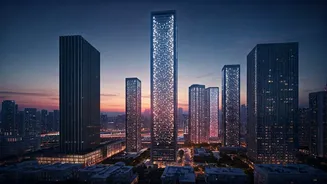




Defining the New Urban Landmark
They are not quite sculptures, not merely light poles, and far more ambitious than simple flagpoles. Across the country, cities are installing ‘lit vertical towers’—tall, slender structures designed to serve as visual anchors in dense urban environments.
Think of the iconic gateway pylons at Los Angeles International Airport (LAX), a series of 15 glass towers that glow with an ever-changing rainbow of colors. Or consider the Reunion Tower in Dallas, whose geodesic dome is wrapped in a dynamic LED light show visible for miles. These aren’t just buildings with lights slapped on them; they are purpose-built objects where light *is* the main event. In cities like Philadelphia, the Cira Centre’s façade acts as a massive, low-resolution screen, while other municipalities are investing in kinetic light poles that respond to wind or pedestrian traffic. They are becoming the 21st-century answer to the 20th-century town square fountain: a central, identifying feature that gives a neighborhood its unique character.
The Vertical Answer to Crowded Spaces
So, why the sudden vertical obsession? The answer lies in the headline’s key phrase: “space starved.” As American cities become denser, the ground level is prime, and expensive, real estate. The luxury of setting aside a full city block for a sprawling sculpture park or a grand plaza is dwindling. Planners and architects must now think vertically to create a sense of place. A slender, 100-foot-tall illuminated pillar occupies a tiny physical footprint but commands a massive visual one. It can create a landmark without displacing housing, retail, or vital infrastructure. These towers slice through the visual clutter of traffic signals, billboards, and generic building facades to offer a clean, memorable focal point. For new mixed-use developments or revitalized industrial districts, a unique lighting installation can instantly bestow a modern identity, signaling that the area is safe, vibrant, and forward-thinking. It’s a cost-effective way to engage in placemaking when you can’t build out, so you build up.
More Than Just a Pretty Glow
While aesthetics are the primary driver, these towers are often Trojan horses for next-generation urban technology. Their height and strategic placement make them perfect hosts for a suite of ‘smart city’ hardware. Many new installations are designed to discreetly house 5G cellular nodes, helping to blanket dense areas with high-speed wireless service. They can also be equipped with environmental sensors to monitor air quality, microphones for gunshot detection, public Wi-Fi hotspots, and high-resolution security cameras. By bundling these functions into an artistically pleasing package, cities can upgrade their technological infrastructure without dotting the landscape with ugly, purely functional poles. This fusion of form and function makes the projects more palatable to the public and easier to fund, as they solve multiple problems at once—improving public safety and connectivity while also delivering a dose of civic pride and beauty.
Lighting the Way for Safer, Softer Cities
Beyond the tech and the spectacle, the rise of lit vertical towers speaks to a growing understanding of the psychology of urban lighting. For decades, city lighting was about brute-force function: flooding streets with harsh, yellow-orange sodium vapor lamps to deter crime. While safety remains paramount, designers now recognize that the *quality* of light matters. The soft, ambient, and often colorful glow from these towers creates a more welcoming and less intimidating atmosphere. It encourages people to linger, to gather, and to feel more at ease in public spaces after dark. This approach, sometimes called ‘light-scaping,’ uses light to guide people, highlight architectural features, and create a cohesive nighttime identity for a district. It replaces the stark, uniform glare of old-school streetlights with a layered, more theatrical experience that can transform a utilitarian street corner into a memorable urban room.