






It's a Whole New Space Race
Forget the two-horse race of the Cold War. The new lunar push is a crowded field, and the playbook has completely changed. The biggest shift? The rise of private industry. In the Apollo era, NASA did everything—it designed the rockets, built the landers,
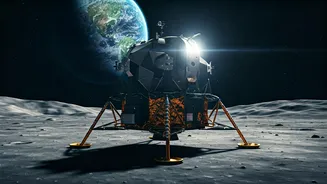
and trained the astronauts. Today, it’s acting more like a savvy customer and anchor tenant. Through its Artemis program, NASA’s goal is to establish a sustainable human presence on the Moon, but it’s buying the ride there from companies like SpaceX. Elon Musk’s Starship, the colossal rocket designed to carry humans to Mars, is contracted to be the landing system that will put the first astronauts on the lunar surface since 1972.This public-private model has slashed costs and accelerated timelines. We saw this in action with recent commercial moonshots. Companies like Intuitive Machines and Astrobotic—names unfamiliar to most just a few years ago—are now launching their own landers, carrying a mix of government science experiments and commercial payloads. While not every attempt succeeds, the message is clear: the barrier to entry for reaching the Moon has fundamentally lowered. It’s no longer the exclusive domain of superpowers, but a new frontier for ambitious businesses.
A Gold Rush for Water and Resources
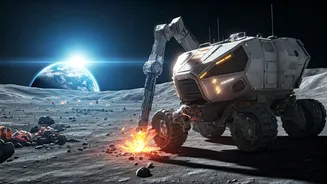
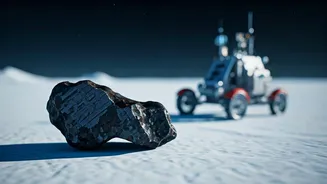
So why the sudden commercial interest? It’s not just for bragging rights. The Moon, particularly its permanently shadowed craters at the poles, is believed to hold vast reserves of water ice. And water is the oil of the solar system. It’s not just for astronauts to drink; it can be broken down into its components, hydrogen and oxygen, which are the primary ingredients for rocket propellant. The ability to “refuel” in space would be revolutionary. A spacecraft launching from Earth wouldn’t need to carry all the fuel for its entire journey. It could top up its tanks at a lunar gas station before heading to Mars or deeper into the solar system. This single resource transforms the Moon from a desolate rock into a critical piece of interplanetary infrastructure. Beyond water, there’s also interest in Helium-3, a rare isotope on Earth that could theoretically fuel future fusion reactors, and other valuable minerals. This resource potential is fueling a modern-day gold rush, with companies and countries staking their claims.
Geopolitics Looms Large
Where there’s competition for resources and strategic territory, geopolitics is never far behind. The new lunar focus is also a reflection of rising tensions back on Earth. The United States is leading a coalition of nations under the Artemis Accords, a set of principles for peaceful and transparent lunar exploration. It’s an explicit attempt to establish international norms for operating on the Moon. Noticeably absent from the signatories are the two other major space powers: China and Russia. They have announced their own plans for a joint International Lunar Research Station. This sets up a clear geopolitical rivalry. While officials on both sides talk about science and cooperation, the subtext is about influence, strategic positioning, and securing access to those valuable polar resources. Countries like India, which recently became the fourth nation to successfully land on the Moon with its Chandrayaan-3 mission, and Japan are also carving out their own roles, making lunar politics a complex, multi-polar game.
A Stepping Stone to Mars
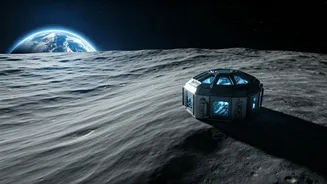
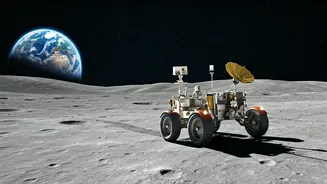
Ultimately, for many, the Moon isn’t the final destination; it's a crucial dress rehearsal. Before humanity attempts the multi-year, technically daunting journey to Mars, we need to learn how to live and work off-world for extended periods. The Moon is the perfect testbed. It’s only a three-day trip away, allowing for relatively quick emergency returns if needed. On the lunar surface, astronauts and engineers can test new habitats, life support systems, rovers, and construction techniques using local materials (a process called in-situ resource utilization). Every problem solved on the Moon—from mitigating the effects of abrasive moon dust to generating power during the long lunar night—is a lesson that makes a future mission to Mars safer and more achievable. The Artemis program isn't just about planting a flag; it’s about building a blueprint for humanity's future as a multi-planetary species.